This photo intrigued me for a couple of reasons. I've written about Gustave Lorey on this blog before - he was a noted Albany photographer. Also, I think this photo was taken at the Lyon Estate at Cedar Hill. Somewhere I've seen a picture of that winged lion statue with the curved bench. Must do some further digging.
Friday, April 14, 2017
Captured Moments at the Albany Institute
So last weekend I attended the Albany Institute's Beer & the Erie Canal fundraiser and wandered into their exhibition Captured Moments: 170 Years of Photography from the Albany Institute. What a wonderful show with many, many interesting local history photographs. Below are a couple of my favorites, because they are from Bethlehem of course. My apologies for the poor quality - this fundraiser involved beer after all - and I snapped these with my phone. Get on down to the exhibit before it closes on May 21!!!
Notice the Hudson River in the background of this photo? It was likely taken at the Learned family property in Selkirk. Judge William Law Learned purchased property on the bluff over looking the river in 1870 for a summer getaway. The property later came into the Peltz family through the Judge's grandson Wiliam L.L. Peltz. The Katherine pictured above is probably the Judge's wife. The 1880 U.S. Census has the Judge, his wife Catherine Dewitt, three daughters (Mary, Grace and Mable), his mother-in-law Elsie DeWitt and three servants (Jennie VanReekum, Minnie Digner, & Maria Shanahan) living on State Street in Albany.
This photo intrigued me for a couple of reasons. I've written about Gustave Lorey on this blog before - he was a noted Albany photographer. Also, I think this photo was taken at the Lyon Estate at Cedar Hill. Somewhere I've seen a picture of that winged lion statue with the curved bench. Must do some further digging.
Thursday, April 6, 2017
100 Years Ago Today the U.S. Entered World War I
The Bethlehem Historical Association has published a special edition newsletter commemorating the U.S entry to World War I which was 100 years ago today, April 6, 1917. Head on over to their website, bethlehemhistorical.org , and look for the DOCUMENTS tab at the top.
So never mind the link to BHA website - I am having trouble getting the PDF to load, really not tech savvy here - but I wanted to publish this blog post on the actual day - so I am publishing it - and will fix the link to the newsletter as soon as I can!
Also, there is a great round up of World War I info in today's Times Union newspaper. Here are a couple of links.
http://www.timesunion.com/local/article/World-War-I-gallery-of-Times-Union-April-1917-11053824.php#photo-12675679
http://www.timesunion.com/local/article/Local-museums-spotlighting-N-Y-s-role-11053820.php
And finally, below is the article I wrote for the February 2017 edition of Our Towne Bethlehem that takes a look at John Dyer, a Bethlehem veteran of the war.
I often close these blog posts by saying "Enjoy!" but that doesn't really work for today's post. So, I think I'll end with BHA's motto: Live for Today, Dream of Tomorrow, Learn from Yesterday.
Bethlehem During World War I
A Look at John Adams Dyer
100 years ago
in April, the United States of America entered World War I. Centennials such as
this offer a time to pause and reflect and wonder about our local history
during a transformative era in American history.
Perhaps
you’ve heard of Nathanial Adams Blanchard?
The Blanchard Post in Delmar is named after him and every year before
the Memorial Day Parade, the members of the post lay a wreath at his gravesite. Blanchard, son of Grace Adams and Clarence
Blanchard, was killed in action in France on November 9, 1918, just two days before
the armistice of November 11. But have
you heard of his cousin, John Adams Dyer?
His story too has a tragic ending.
John Adams
Dyer is the son of Jessie Adams (sister of Grace) and Zeb A. Dyer. The couple married in 1889 and their son John
was born in Delmar September 24, 1891. Zeb was a prominent lawyer active in the
Democratic party and elected Albany County District Attorney in 1899. He died
of typhoid fever at the age of 43 on September 18 1904. John was not quite 13 years old.
The Dyers
lived right next door to the Blanchards on Kenwood Avenue in the heart of the
Four Corners. One can imagine the
cousins, four years apart in age, hanging out together. Dyer went to the Albany
Academy and was on the baseball and hockey team. His time there, with the
academy’s emphasis on military procedures and training in leadership, would
have served him well after his enlistment. When he filled out his Draft
Registration Card, Dyer listed his place of address as Delmar and occupation as
automobile salesman with H. E. Lishman in Troy, NY.
Congress
declared war on Germany on April 6, 1917, but it took time for the U.S. to gear
up. On June 26, the first 14,000 troops
arrived in France to relieve the war battered soldiers of France and Great
Britain. It wasn’t until the summer of
1918 that U.S. troops arrived in Europe in large numbers. The Selective Service
Act was enacted in May of 1917. From
these registrations, the U.S. military built up and by the end, over four
million people had been mobilized for the war effort. John Dyer was among the first rounds selected
for Albany County. On September 8, 1917,
he was inducted at Delmar, and he and other Albany County men soon found
themselves on a special train bound for Camp Devens in Ayers, Mass.
Camp Devens
was the regional cantonment set up to train the draftees. Dyer was assigned to 76th Division
of the National Army, Company L of the 303rd infantry. By the time his unit was sent overseas on July
7, 1918, Dyer was a Sergeant. The 303rd
was part of the American Expeditionary Forces.
Reportedly, the 76th was assigned to a depot division at St
Aignan, France and the division was soon broken up with cadres of soldiers going
to the front to replace and relieve those already in place. One source for the 76th division
“battle honors” lists the St. Mihiel Offensive, a successful drive by General Pershing’s
forces against the Germans.
Here we lose
track of Dyer specifically. Was he
assigned to the frontlines in France?
Did he experience the horrors of trench warfare? The blasts of
artillery? The fumes of mustard gas? The death and destruction? We simply don’t
know. His record indicates that he
served overseas from July 7, 1918 until July 9, 1919. At the time of his honorable discharge on
July 30, 1919, he was a Second Lieutenant. Dyer then came home to Delmar, and
lived with his mom.
We know he
continued as a car salesman, and later was a salesman for Dearstyne Brothers,
purveyors of fine cigars. He was a
member of the Masters’ lodge of Masons, the Knights Templar and the
Shrine. The local newspapers have a few
mentions of Dyer after he came home from the war. In 1922, he helped organize a social for the
Delmar Democratic Club (a concert and dance at the Delmar fireman’s hall). In
1923 there is a mention of his name in a long list of attendees of a Tawasentha
Chapter DAR card party and dance also held at the Delmar firehall. And then
there is this headline from the January 2, 1925 issue of the Altamont Enterprise: “John Dyer Dies of
Gas Fumes in Delmar Garage.” His mother Jessie found him behind the wheel of
his car in a closed garage dead from carbon monoxide poisoning. He was just 33
years old
What to make
of this tragic story of a life cut short? Bethlehem’s local history is part of
the story of our national history. Many from Bethlehem served overseas in the
military during World War I. Many others
remained behind and supported the war effort on the home front. What was Bethlehem like 100 years ago? The Bethlehem Historical Association is
exploring questions like these and is looking for your input. Was one of your relatives a Doughboy serving
on the Western Front? Perhaps one of your family was part of the Woman’s Land
Army or served with the Red Cross?
Please consider sharing your information. You may contact me at sleath@townofbethlehem.org
or contact Karen Beck of the Bethlehem Historical Association, 439-9260, bethhist1965@gmail.com.
Monday, March 27, 2017
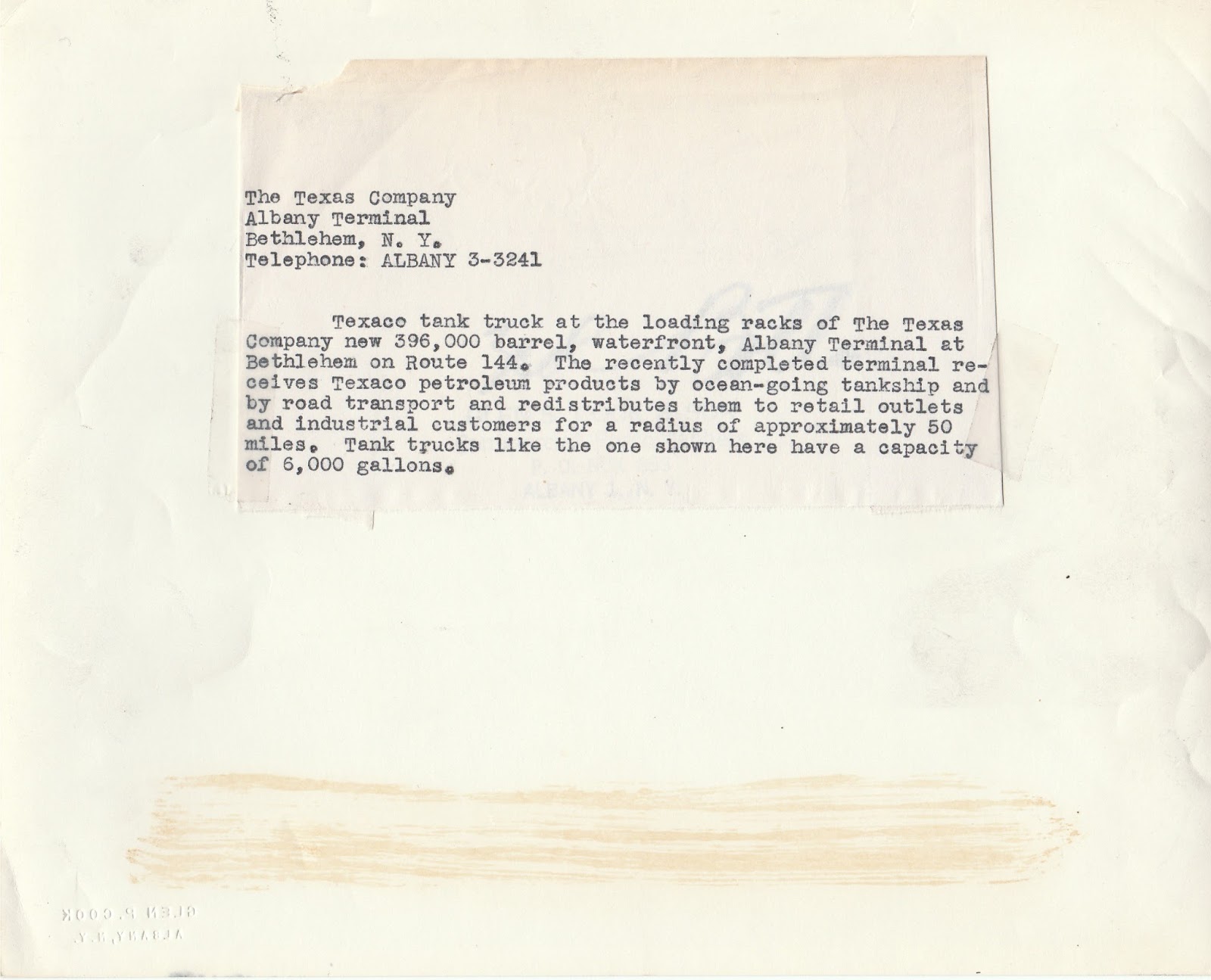
Texaco tanks then and now
Here's a fun then and now for your Monday morning. A gentleman from Innovative Surface Solutions wondered if I had an old photo of the tank farm on River Road in Glenmont. Yes I did and here it is. He then returned the favor with the now photo. Enjoy!
And in case you are curious, here's the info from the back of the old picture.
Tuesday, March 14, 2017
Thoughts about Glenmont and Frazertown
The wooden objects are keg taps or spigots. The one in the foreground was made by John Sommers. Below is one of their advertisements from 1908, plus, just for fun, the masthead of the magazine it came out of.
![]() |
Also in the photo is a piece of blue and white pottery and the bowl of a clay pipe. The pipe is probably from the mid 1800s.
First up The Glen. Based on old maps and the story told by the Maiers, I think this is a reference to the Hurlbut farm (sometimes spelled Hurlburt), pictured below in a photo I stole from Google. The book Albany Chronicles describes it as "the country-seat at Glenmont, upon the eminence west of "The Abbey."
Mr. G. D. W Hurlbut is Gansevoort DeWandlaer Hurlbut (1857-1901) son of Elisha Hurlbut (noted NY Supreme Court justice) and Catherine C. VanVechten Hurlbut.
The other property in the story is The Mont or The Mount. I believe this is the Patterson farm located up the hill from Anders Road off of a long driveway on the right. Conveniently, this property at 111 Glenmont Road is for sale if you would like to spy it out. Top picture is from Zillow. The bottom one shows the house back in the day and is courtesy of the Bethlehem Historical Association.
BHA records indicate that this is the Patterson house, Glenmont Hill which matches up with the old maps of the area. The town's OARS system says the house was built in 1901, which lines up with the tenancy of John J. Patterson. A search of the Altamont Enterprise did not turn up any info regarding a property called The Mount. I did turn up the tragic story of John Patterson (John J.'s father) and his nephew James Patterson. Both were killed in September 1898 in an accidental explosion at their stone quarry.
So, I very much like the story of The Glen and The Mont, but so far have not found any primary sources to back it up. For now, I'll call it plausible but not proven.
And a final note...wonderfully, the 1880 US census has the Frazers, Hurlbuts and Pattersons all on the same page.
Dwelling house 285 is the Fraziers (John and Ann and their daughters Jane, Kate, Mary, Sarah & Elizabeth.)
Dwelling house 286 is the Pattersons (head of household John and his son John J. daughter Louisa Rockefeller and her husband BR, nephew James Patterson, plus 4 other single adult men.)
Dwelling house 293 is the Hurlbuts ( E.P. and wife Catherine, sons Gansevoort and Ernest, plus George Pattendon farm laborer, Catherine Cahill and Elizabeth Callahan domestic servants and Elizabeth Callahn, cook.)
Tuesday, January 31, 2017
Looking for John I. Slingerland
Lately, I've been looking into the background of John I. Slingerland - scion of the hamlet of Slingerlands, U.S. Congressman (13th District, 1847-49), NY State assemblyman (1843, 1860), husband of Sally, farmer, landowner, anti-renter - and have come up with a few news clippings I'd like to share.
First the Bad News reprinted in the September 12, 1858 issue of the Oneida Morning Herald from the Albany Express about John I's rotting potato crop. Not that crop failure is funny, just the language amuses my 21st century ears. I am imagining exploding potatoes all over town.
Here's one about John I's appearance at an Anti-Rent rally published in the New York Daily Tribune on December 30, 1857. The writer is amused by Slingerland's "style of oratory" and the fact that "with a great deal of irrelevant talk he contrived to mingle facts and anecdotes that caught the attention and enlisted the sympathies of his audience."
Here's another that notes how his "firm and manly adherence to the principles of his party will produce a greater effect upon the masses..."
And my favorite so far, A Delightful Drive. It was published in the Albany Morning Express, Tuesday Augsut 13, 1861.
P.S.I hope you can read the articles from the pictures - I was too lazy to transcribe them all ;)
Thursday, January 12, 2017
Maria Louisa Kissam and William Henry Vanderbilt
Maybe you've heard of the famous Vanderbilt family? They are on my mind because of a fun Bethlehem connection.
It started with this little blurb in the T.U.
about the "Vanderbilt family homestead at Cedar Hill." I know about the Vanderbilt family connection (more on that in a bit) but a "family homestead'? Your historian is skeptical! I can't find a reference or a location, never mind a photo.
Today's poking around on the internet did turn up a very cute story about how William Henry Vanderbilt and Maria Louisa Kissam met. William is the son of Cornelius - the famous Commodore - and Sophia Vanderbilt. Maria is the daughter of Samuel and Margaret Kissam. Samuel Kissam was the pastor of the First Reformed Church of Bethlehem from 1817-1841. The Kissam family lived in Cedar Hill for those years, possibly at the Nicoll Sill House on Dinmore Road. One of Samuel and Margaret's children is buried at the cemetery there - little Catherine Matilda who died at age 2 in 1828.
The following story of how William and Maria met is told in a newspaper article published by the Jamestown Evening Journal published January 30, 1899. The column is forthrightly entitled "Our New York Letter Gossip About A Playwright, A Humorist, and The Vanderbilts."
Here's a transcript of the article:
Who knows if this story, told by an "old timer" and clearly noted as "gossip" actually happened, but the events described certainly might have taken place here in our little town of Bethlehem. We do know that William Henry and Maria Louisa were married by her father on September 28, 1841 at Cedar Hill and the marriage is recorded in the records of the First Reformed Church. The couple went on to live remarkable lives.
Pop on over to Find A Grave for remarks about Maria Louisa. She was born in Coeymans in 1821 and died in Scarborough NY in 1896.
http://www.findagrave.com/cgi-bin/fg.cgi?page=gr&GRid=92799795
And get thee to Google for more on William Henry Vanderbilt - he is pretty famous you know. And be sure to appreciate his epic sideburns!
It started with this little blurb in the T.U.
![]() |
| Published in the Times Union on Jan. 11, 2017. |
Today's poking around on the internet did turn up a very cute story about how William Henry Vanderbilt and Maria Louisa Kissam met. William is the son of Cornelius - the famous Commodore - and Sophia Vanderbilt. Maria is the daughter of Samuel and Margaret Kissam. Samuel Kissam was the pastor of the First Reformed Church of Bethlehem from 1817-1841. The Kissam family lived in Cedar Hill for those years, possibly at the Nicoll Sill House on Dinmore Road. One of Samuel and Margaret's children is buried at the cemetery there - little Catherine Matilda who died at age 2 in 1828.
The following story of how William and Maria met is told in a newspaper article published by the Jamestown Evening Journal published January 30, 1899. The column is forthrightly entitled "Our New York Letter Gossip About A Playwright, A Humorist, and The Vanderbilts."
Here's a transcript of the article:
A Vanderbilt
Wooing
Something in the papers about the
approaching marriage of Willie K. Vanderbilt, Jr. to Miss Virginia Fair
reminded an old timer this morning of the first meeting between William H. Vanderbilt
– the grandfather of the bridegroom to be – and Mary Kissam, from whose last
name comes the K., now a fixture in Vanderbilt names for two generations.
“William H. Vanderbilt was a
youngster when he first met the girl he was to marry,” said the old timer, “and
was employed at Albany looking after the freight business of the old commodore’s
line of boats. One of the young man’s
fads was riding. He had a magnificent saddle
horse and he used to throw his legs over the beast’s back late every afternoon
for a wild and furious gallop. One
evening on the return ride his horse took fright at the fluttering white
drapery of a young woman on the side walk, reared quickly and threw the rider
to the ground.
“The fall was a heavy one, the rider’s
head struck on a pile of jagged stones, and for a little while it looked as if
he had been seriously hurt, for he lay as supine as a log, and was a very long
time regaining consciousness. Of course,
the girl ran to his assistance, and of course, after he had recovered she insisted
on his entering the house of her parents, which stood nearby, that her mother might
dress the cut in his head. Her father
was the Rev Mr. Kissam. He soon returned
from an evening prayer meeting or something, and the whole family devoted hours
to making their unexpected guest comfortable.
When he was well enough to go to his lodgings, Papa Kissam went with
him, and the young man was invited to call at the house. The young woman being very agreeable to know
and every one in the home exceedingly well disposed toward him the scion of the
house of Vanderbilt accepted the invitation gladly and repeatedly, and in due
time asked her an important question, which she took pleasure in answering ‘Yes.’
“I’ve always thought the romance of
William H. Vanderbilt’s courtship a very pretty one,” concluded the old timer, “though
I must confess it seems quite conventional when you come to analyze it.”
Who knows if this story, told by an "old timer" and clearly noted as "gossip" actually happened, but the events described certainly might have taken place here in our little town of Bethlehem. We do know that William Henry and Maria Louisa were married by her father on September 28, 1841 at Cedar Hill and the marriage is recorded in the records of the First Reformed Church. The couple went on to live remarkable lives.
Pop on over to Find A Grave for remarks about Maria Louisa. She was born in Coeymans in 1821 and died in Scarborough NY in 1896.
![]() |
| Maria Louisa Kissam Vanderbilt portrait by Benjamin Curtis Porter |
And get thee to Google for more on William Henry Vanderbilt - he is pretty famous you know. And be sure to appreciate his epic sideburns!
![]() |
| Photo from the collection of the New York Public Library |
Thursday, December 29, 2016
How do you name a historic house?
WARNING: This blog post contains lots of unanswered questions.
I am off on a tangent this morning thinking about how we name historic houses. This is because I am helping with a project that will produce a Google map of historic sites in town. Specifically for bicyclists, but it will be very useful for all. How do you label all those points on the map?
Is it the Parker-Winne House or the Pieter Winne House? And what about Mrs. Winne, Rachel VanAlen, surely she had a lot to say about the construction of her home? Pieter and Rachel were married January 21, 1720 and their oldest son Daniel was likely born in November 1720 (he was baptized at the Dutch Reformed Church in Albany on November 20.) The house was built sometime in 1720. Can't you hear Rachel telling Peter to hurry up and get the house built before the baby is born? Shouldn't it be the Pieter and Rachel Winne House? And what about Parker? That's Brian Parker, the current owner!
I often use the name Pieter Winne House to distinguish it from the nearby Daniel P. Winne House. This is Pieter and Rachel's son. And again, what about Mrs. Winne? Daniel married Jannetje Deforest in 1744. The house was built in 1751. Already married 7 years, they had two children before the house was built and then had four more. Surely Jannetje was a vital part of this family too. Pop on over to the Metropolitan Museum site for more on the Daniel and Jannetje Winne House. (Yes, I just changed the name. Sounds nice doesn't it?)
http://www.metmuseum.org/toah/hd/dutc/hd_dutc.htm
Is it the Nicoll-Sill House or the Bethlehem House? Nicoll refers to Rensselaer and Elizabeth Nicoll who had the house built circa 1735. Sill refers to Capt. Richard Sill who married their daughter Elizabeth. The Sill branch of the family were later owners. I'm kind of OK with using just the last name. The name Bethlehem House goes way back as well.
And what about houses that have specific names? Is it the Cornelius Baker House or Grand View Farm? This a property that few living today remember by either of those names. That property is owned by Scenic Hudson. Should it be the Scenic Hudson-Baker House?
Here's another, how about the Glynn Mansion? To be fancy, I sometimes say the Governor Glynn Mansion (sadly ignoring Mary Glynn). It is often identified as the former Elks Club or the Mansion at Cedar Hill.
I don't have any answers this morning, but I hereby resolve to always look for the women of the family and reference them whenever I can!
![]() |
| Note the title of this report! |
Subscribe to:
Posts (Atom)