Monday, March 12, 2018

Maria Louisa Kissam Vanderbilt - Revisited

Last night I returned from vacationing in Asheville, North Carolina.  It is a very beautiful place and I had to do all the touristy things including a trolley tour and visit to the Biltmore Estate. And I had an awesome "Bethlehem History Moment" while mixing with the hoards of people touring the famous mansion.

First, here's a picture of the house taken from their website (biltmore.com).  It doesn't show the five million people that were there the day we were. (If you don't like crowds don't go on a Saturday.  Altho I must say, the place is very well run and we had a very nice experience!)


As you go along the self-guided tour, you come to the Tapestry Room.  My eyes were already starting to glaze over a little by this point, but I did turn around to look behind me and saw these portraits on either side of the door.  Who are they?  I wondered.


So I read the tour book, and lo and behold, the woman on the left is our very own Maria Louisa Kissam! She married William Henry Vanderbilt right here in Bethlehem on September 28, 1841. Pop over to this blog post from last year for the story about how they met.
http://bethlehemnyhistory.blogspot.com/2017/01/maria-louisa-kissam-and-william-henry.html

What a fun surprise!

That's Maria Louisa - portrait by John Singer Sargent.
And that's her son George Vanderbilt - who had this whole amazing Biltmore Estate built -
portrait also by Sargent
The portrait on the right is Edith Vanderbilt - daughter-in-law of Maria Louisa.
So, then I started imagining this young woman, who grew up in Coeymans (!) and her experiences in this particular house. Her son's home. 

Below is the whole write up that appeared in the New York Times when Maria Louisa died in 1896. I copied and pasted from Findagrave.com because I really want you to read it!  I don't think she ever forgot her roots and upbringing in rural Albany County. 


Mrs. W. H. Vanderbilt Dead.

Stricken with heart failure at Scarborough.

Mrs. William H. Vanderbilt died suddenly yesterday afternoon at the country residence of her daughter, Mrs. Eliott F. Shepard, at Scarborough, N. Y. of heart failure. She had suffered from a weak heart for several years, but her demise was entirely unexpected. Mrs. Vanderbilt had been at Mrs. Shepard's house for about three weeks, and was present at the wedding of her grand-daughter, Edith Shepard, to Ernesto Fabbri. About noon yesterday she dressed for her daily drive and appeared to be in good health. But just before the carriage arrived she had an attack of heart failure, and decided to abandon the drive. She went back up stairs, and about 1:30 o'clock her heart failed to act and in a moment she was dead. The end came painlessly. Dr. Constant, a local physician, was summoned when the attack came, but his efforts to prolong life were unavailing. Dr. James W. McLane of 51 West Thirty-eight Street, the family physician in New York, was notified by telegraph. He hastened to Scarborough as fast as a special engine could convey him, but Mrs. Vanderbilt was dead when he arrived. The only relatives with Mrs. Vanderbilt when she died were her daughter, Mrs. Shepard, and her sister, Mrs. Bromley, Cornelius Vanderbilt is at Newport convalescing from his recent attack of paralysis. He will be unable to go to Scarborough, but will come to New York for the funeral. William K. Vanderbilt was in New York. George Vanderbilt is at Biltmore, N.C. and Frederick was at Hyde Park, on the Hudson. Mrs. William D. Sloane, another daughter, is at Lenox, Mass; Mrs. Seward Webb is at Shelbourne, Mrs. Fabbri is on her way to England, Mrs. H. McK. Twombly was at Madison, N. J. and Mrs. Harry Payne Whitney, who was Gertrude Vanderbilt, is in Japan. All members of the family who were near New York arrived at Scarborough last evening. Chauncey M. Depew and James Hatmaker, Cornelius Vanderbilt's private secretary, went to Scarborough yesterday afternoon. Dr. Depew said last night no arrangements for the funeral had been made. The body will probably be brought to New York to day and the funeral will be held from the home at Fifth Avenue and Fifty-first Street Monday or Tuesday. Definite arrangements for the funeral cannot be made until the members of the family meet. The body will be buried in the family vault at New Dorp, Staten Island. The life of Mrs. William H. Vanderbilt was one of Aladdin like changes. She passed through every saga from a poor farmer's wife on Staten Island to a palace on Fifth Avenue and the distinction of being the wife of one of the wealthiest men in the world.

She was married to William H. Vanderbilt in 1841. Her husband at that time was a clerk in the office of Dean Robinson & Co., bankers in Wall Street, at a salary of $16.00 per week. The old Commodore took very little notice of either his son or his daughter-in-law. William was bound to "go to the dogs" anyway, he thought, and he did not intend to waste his substance and energy in trying to prevent the inevitable. The young people did not have sufficient means to furnish a house, so they boarded in East Broadway, which was then a very good part of the city, living happily on their small income. The additional responsibility impelled the young husband to devote greater energies to business. Indeed, the firm was seriously considering the advisability of taking him into partnership, when he was obliged to give up indoor work on account of the failure of his health. His father, realizing that, unless he did something, his son would soon die, purchased for him a little farm at New Dorp, Staten Island, and told him to make the best of it. Thither the young wife accompanied her husband. They found the farm to be seventy acres of unimproved land. They were both ignorant of farm life, but together they undertook a calling which required patience, sagacity, economy, and untiring energy. The motto of the husband was never to attempt what he could not do, and never to fail where work would win. The wife, with a thrift inherited from her sturdy ancestor, aided him in every way. In these early struggles, William H. Vanderbilt often said, her influence was potent for great good, and to that influence he attributed much of his courage at this period of his life. Under the combined efforts of the two the barren little farm was transformed and soon brought in a good income. Life became easier for the young wife. Her husband, by his energy, soon had 350 acres under cultivation. Then came the reconciliation of the father and son. The Commodore at last believed there might be "something in William." From that time there was no more farm work for the young wife. Her husband was soon after made receiver for the insolvent Staten Island Railroad. So well did he handle this property that from on extreme the father went to the other. Nothing was too good for him. Position after position was given him, until, in the old age of the Commodore, William H. Vanderbilt was his father's confidential adviser-at his death the principal heir. During these changes the wife steadily devoted herself to her household and her increasing family of children. She was exceedingly simple in her mode of life. She rose early and after attending to her household duties spent most of her time in the care of her children. After they were married she took the same interest in her grandchildren, visiting them or having some of them brought to her every day. Before she became enfeebled she was accustomed to take a drive in Central Park every afternoon, accompanied by one of her daughters. She always dined very quietly and retired early. Mrs. Vanderbilt was of a religious disposition and very regular in her attendance at St. Bartholomew's Church, Fifth Avenue. She was charitable, but in an unostentatious way. Her name seldom appeared in the list of the leading charities, but it is known that she contributed largely to them in a quiet manner. It is said she generally requested that her name should not be mentioned with her contributions.

From the New York Times November 7, 1896.


And finally,

Further along in the tour, in the Oak Sitting Room is the portrait below.  The guide book says this is "Mr. Vanderbilt's aunt, Mrs. Benjamin Kissam." So a sister-in-law to Maria Louisa.  It was also painted by John Singer Sargent.


Stage Finds

In the ongoing saga of things that turn up on my desk I give you the picture above.

Did you know that they are working on the stage area in the auditorium at Town Hall? (It became structurally unsound, so the space is being renovated to accommodate the food pantry and rework the area where the Town Board sits.)

Do you remember that Town Hall is the former Delmar Grade School?

The items above were all found "under" the stage, a couple of them were actually crammed into the wood work.

As always I wonder what the story was.

This blue tin looks to be a cigarette box.  Edgeworth Extra High Grade Ready-Rubbed was manufactured by Larus and Brother Company of Richmond, Virginia.  Probably from the 1930s.  I imagine kids sneaking a smoke under the stage after school!


The calendar is for the year 1933 and I wish it still had the picture in the middle.  It advertises the Delmar Dry Cleaners, 337 Delaware Avenue.  Dial 9-832.   Love that phone number!


How about this bus schedule from 1926? Catch a ride in Albany at 10 AM and arrive in Delmar 26 minutes later.  I really wonder where the specific bus stops were for Albany, Normansville, Elsmere and Delmar.  Obviously along Delaware Avenue, but where exactly?


This is an envelope from the Home Savings Bank in Albany - wish we could still get the 4 1/2 % interest rate!


And finally, this sheet that looks to be a page of spelling homework.


I would really like to know if anyone remembers Stephen Gates and how his fourth grade paper ended up stuffed in the wood work under the stage!  Let's see, if he was around 9 years old in 1964 that makes him about 63 today. And because I can not help myself, here's his BCSD 1972 yearbook picture.  That's him, top left.


Many thanks to the folks working on the project who rescued these items.  You saved some fun bits of Bethlehem history!

Thursday, February 1, 2018

Slingerlands' Suburban Roots

Oh my how times have changed.  Or not.  That is the thought that crossed my mind when I stumbled upon this article while looking for something else.

It was published in the April 21, 1911 issue of the Altamont Enterprise, 100+ years ago when the word suburban did not have the negative connotation of "suburban sprawl" attached to it.


SLINGERLANDS IS SURELY BOOMING
BIG REAL ESTATE DEALS CLOSED

Albanians Seeking Homes Here - Lots are Being Sold and Several Houses Will be Erected at Once - Advantages Unexcelled as an Ideal Suburban Locality.


In 1911, Slingerlands is described as an "ideal suburban residential section with numerous advantages being but eighteen minutes from Albany by steam...village water, electric lights...paved sidewalks...telephone and telegraph service..."

It goes on to note that several properties have come on the market at reasonable prices "thereby giving outsiders the opportunity to locate here... to take advantage of this welcome."  Of note was the Blessing Land Improvement company that was developing the Blessing farm by selling building sites, laying out streets and sidewalks to make the "most desirable location to build homes."  (This is the area around today's Union Street)

Sound familiar?  The tone of the article is pure rah, rah booster-ism.  And yet, the last line...


"The boom is on in Slingerlands! It's up to our citizens to help push it along.  Don't knock - Boost! with a big B"

The implication is that someone was knocking all this development. Perhaps fighting it, desiring to preserve open space and the old farms.  Sound familiar?

This is still an issue for modern day Bethlehem to wrestle with. Personally, I recognize the tension between the rights of property owners and my desire to preserve every, single old house, barn, and landscape setting.  Every one.  Well, I am realist enough to know that that is not possible, nor is it fair to the owners of these properties. We've got an excellent planning department that enforces zoning codes and provides an open process on development.  We've got a  new conservation easement program.  But most importantly we have a committed citizenry that keeps these issues on the forefront working towards an equatable balance that preserves the quality of life in our town.

*********
And while we are on the topic of Slingerlands, how about this poem that mentions its brief time known as Ruxton. (Thank you Chris P. for passing along this gem.)

"Old Slingerlands, is a lovely place
And the people we prize very dearly,
For we always find them running over with grace
And that is why we live here yearly.


Tuesday, January 2, 2018

Oh Delmar, Your Name is Mystery

Bark, bark, bark.  That is me, your town historian barking up the wrong tree for years now!
Did you see the article in today's Times Union about the name Delmar? Hop over and take a look. 


https://www.timesunion.com/local/article/In-Delmar-there-is-a-mystery-12465812.php#photo-14776363


The author Larry Rulison and I have exchanged several emails about the name Delmar.  I'm convinced of the railroad angle, he proposed a name after a California resort.  Well, I got another email this morning that introduces the U.S. Post Office into the mix, and I must confess, the evidence here is pretty convincing!


Check out the link below about nineteenth century U.S. Post Offices.  The article makes a pretty clear declaration:


Adams Station - Delmar
Established: April 22, 1868
Name changed to Delmar" September 28, 1885.


http://www.esphs.us/wp-content/uploads/2016/11/Albany-county.pdf


Then there is this newspaper clipping from the Albany Times dated Friday evening, October 2, 1885.


"The postoffice "Adams Station" has been changed to "Delmar" which name it is supposed will also take the place of "Adamsville" as a railroad and express station."


There is also this bit from John R. Adam's obituary published in the Albany Evening Journal in February 18, 1905:


It says in part, "Nathaniel Adams, his father,...owned a great  deal of property where Delmar now is and the place was named in his honor.  About twenty years ago the name was changed to Delmar, as there was an Adamsville in Jefferson county and another in Washington county, and mail addressed to residents of these places often was miscarried."


So there you go folks, the name Delmar is the post office's fault.  Thank you Chris Philippo for helping us set the record straight!


But did you notice, we still  haven't answered the question, "why Delmar?" 
Larry, maybe it was California!!!

Tuesday, December 5, 2017

The Bradt-Oliver House

For the October 2017 issue of Our Towne Bethlehem I wrote about our area's old stone houses, especially those of the Onesquethaw Valley Historic District.   Illustrating the story, and gracing the cover, was this image of the Oliver-Bratt house on Van Dyke Road.


My caption for the photo simply said "The Bratt – Oliver House on Van Dyke Road has undergone many architectural changes over the years.  It is now part of the Spinney community and was once part of the Leonard Farm."

I am pleased to report that a member of the Leonard family, Brian Leonard of North Carolina, reached out to Our Towne with more photos and remembrances of growing up in this home on Van Dyke Road.   I like Brian's way with words, and with his permission, here's his whole letter.  Enjoy!
Circa 1940

Dear John and Marjorie,

      A couple of weeks before today, Thanksgiving 2017, I was visiting with my dad, Richard Leonard, and he shared a copy of the October 2017 issue of Our Towne that my aunt Barbara had sent to him. What a pleasant surprise to see my childhood, ancestral, home on the front cover.
     As is usual for a couple of old men, that led us down a path of reminiscing about the [Leonard] farm. Not that it makes me any more special than anyone else in this world, but the thought of that farm, and how my family’s history was so closely tied to it, always makes me feel like the I am the luckiest man in the world.
     Lucky me, I’m the last in line. Quite literally, arguably, the last of my family to be born and raised at 246 Van Dyke Rd.  While the farm only carried the name Leonard for a brief time, beginning around 1920 when my great grandfather Ralph Irving Leonard bought the farm from his sister in law and ending with the sale to the owner’s of Spinney Preserve, it has been part of my larger family’s heritage since the Van Rensselaers were the prominent landholders in the area.
     The house, now called the Bradt-Oliver house, (both names show up in the Leonard genealogy) was an absolutely idyllic place for a boy to grow up, and even though I didn’t understand its personal historic significance, I relished the fact that the house I was raised in wasn’t your typical modern home. Add a little over one hundred acres to the scene and it becomes obvious why that place is special.
Circa 1940

     The old stone part of the house, the original house, caught my great grandfather’s eye and he spent a long time turning it into his dream home with his wife, Lillian Salisbury. Prior to buying the farm he had been a carpenter for the NY Central RR and used those skills, and timber harvested from the farm, to more than double the living space during the 1950’s and early 1960’s. I have heard a few rumors over the years that there are stories of an even older cabin having been on, or near, the house site but no one that I’m aware of has presented any real evidence.
     The original part of the house was, as you noted, built some time before 1768, and was a fairly typical pre-colonial Dutch influenced home. A simple rectangle with stone walls almost 2 feet thick chinked with a combination of mud and horse hair. It was built as a single living level split into two rooms, with a haymow above and a cold cellar below.  The floors are all hand hewn tongue and groove with beams that measure better than a foot across. One of my favorite things about “the front room” (our term for the old house) were the twelve over twelve windows. I’ve visited the house a few times over the years since moving away and am sad to see those windows have been replaced. To my own discredit, however, I personally may have had a little to do with that, having broken and repaired several panes during childhood activities.

     I don’t recall the details but I do recall seeing names and dates here and there on the old woodwork. Though I’ll add the most notable date to me, 1807, was carefully carved in a beam of “the big barn” that once stood on the other side of Van Dyke Rd.
     I don’t think I’m alone in feeling that, as youngsters, we all tend to be too busy growing up to notice, or care about, these things. But as I’ve aged I’ve come to see that is something almost all of us look for. Our place. Where we are, where we’re going, where we came from, who our people are.  And that is one of a myriad of reasons why I feel so lucky. Last in line or not, I was given a rare chance to grow up steeped, literally, in my peoples history.
     I could go on and on, boring you with stories of life at that end of Van Dyke Rd. Such as how songbirds nesting in the stone walls surrounding my bedroom would wake me, literally, every day an hour before sunrise, or snowshoeing the snow covered fields on a pair of bear paws that “are older than I am” according to my dad. Plus other rites of passage, like the sunny summer morning of my seventh year when my grandfather, Irving Ralph, stuck me on the Ford 8n his father bought new in 1947 and taught me to drive. And for you romantics things like first kisses in the barn’s haymows.           But I digress.
     I will close with this thought. I believe we honor our ancestors, near and far, by remembering them. Thank you for taking your time and remembering some of mine.

Brian Leonard
Circa 1988

Monday, November 27, 2017

A Slingerlands Postcard

(Seeing as how I haven't posted in a while - here's two in one day!)

Poking around in the two dollar postcard box in an antique store in Cohoes (shout out Dennis Holzman) this weekend I came across a few wonderful finds for my own collection.  The Indian Ladder at Thatcher Park, Albany at Night, and these Bethlehem beauties.


The top and bottom ones are familiar, I think they've both made an appearance on this blog, but it is fun to have my own copies.  The one in the middle is a new one to me.


I immediately wondered about the West Main Street part.  I have never heard or seen New Scotland or Kenwood referred to as Main Street, never mind West Main Street.  Maybe it is a stock photo, but maybe it is our Slingerlands.  When blown up in a larger view, the houses visible in the trees on the left could be ours. So I am calling this one plausible. 

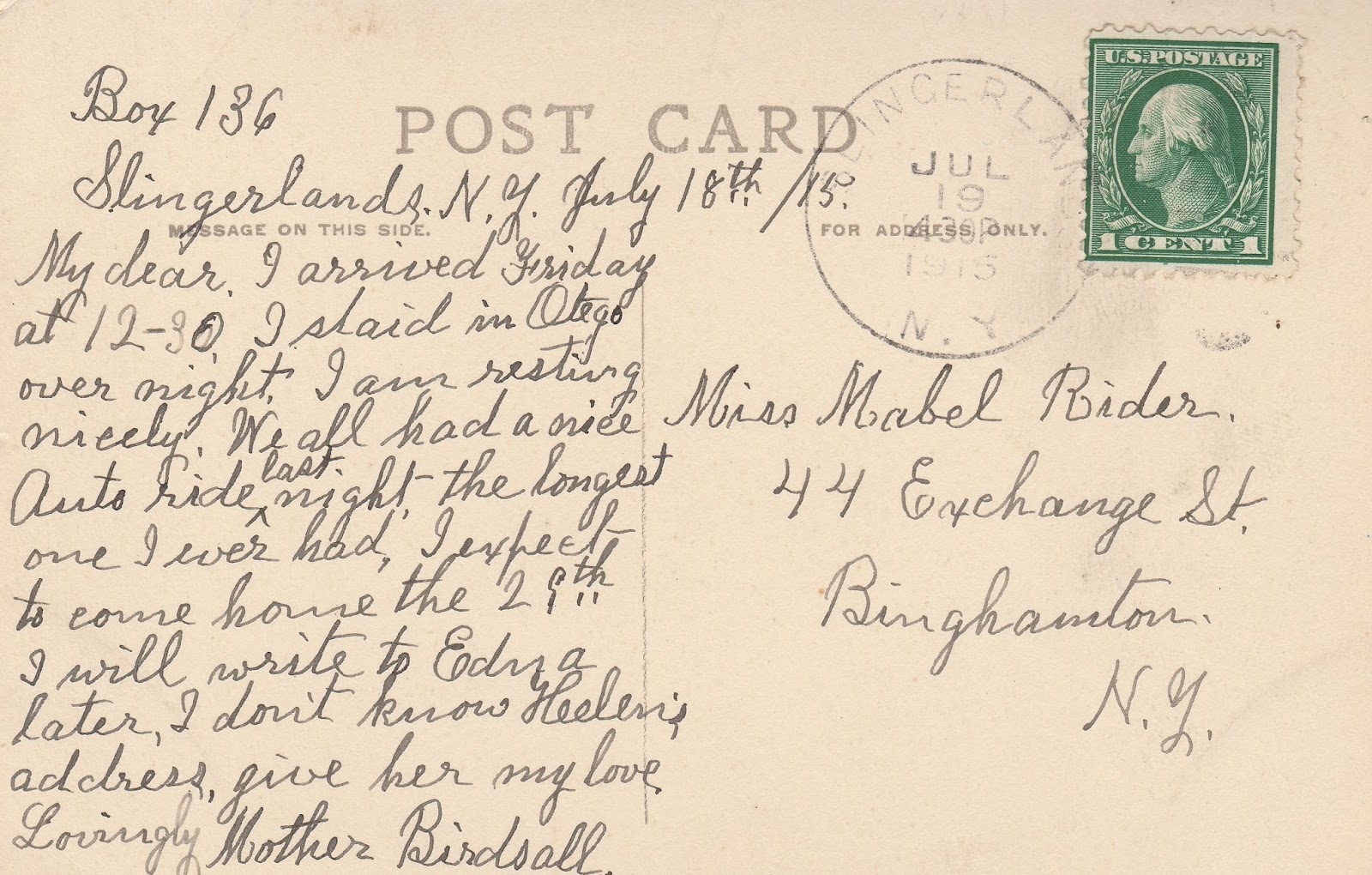
What I really enjoyed was the message on the back and Mother Birdswell's comment about her "nice auto ride last night, the longest one I ever had."  The card is postmarked July 19, 1915.


Bethlehem Downs

I've been hanging out at the Delmar Farmer's Market the last couple of Saturdays with the good folks of the Bethlehem Historical Association.  I enjoy talking about our history and  listening to people reminisce about growing up here.  I'm often asked if I know anything about specific houses and wish I had old photos of each and every one. Sometimes, people like to play stump the historian, which I must confess is often too easy to do.

One gentleman handed me this card and asked me if I had ever heard of the racetrack off of 9W near the Raven/Coeymans line.  I've written about horse racing in Bethlehem before, but had never heard of the Bethlehem Downs. 


So of course, this afternoon I had to do a little newspaper sleuthing. 

Turns out in 1972, Charles Russo and his son Peter proposed the Bethlehem Downs quarter horse track.  They said it would be the "plushest" in the racing industry. They held a ground breaking in June of 1973 and one newspaper reported plans for a $200,000 purse.  Unfortunately, the Russo's plans don't seem to have come to fruition. The Ravena News-Herald, in February 1974, reported that Dawn Branstrom was enjoying her new quarter horse, a Christmas gift from her parents.  They go on to say, "We don't know if she is getting ready for Bethlehem Downs when and if it opens, but we do know she is going to be one of Selkirk's most ardent horsewomen."  The latest newspaper article I found is from March 1976 when the Jigger Sports columnist (in the Leader-herald of Gloversville) reported on the Down's financial struggle and complications of getting the track off the ground.

Seeing as how this is an article about quarter horse racing, hop on over to the American Quarter Horse Association website for some info on quarter horse racing.  As they say, "Quarter Horses are traditionally short, stocky horses that are specialized sprinters.  They are the dragsters of the horse racing world."  Pretty different from the long legged darlings of Saratoga!

https://www.aqha.com/daily/riding/2016/riding-archive/american-quarter-horse-racing-basics/


PS Thank you Bill S. for this fun round of Stump the Historian!