Friday, February 18, 2022

The Niver-Strumpf House & The Jericho Drive In

Last year, the Bethlehem Historical Association highlighted all of Bethlehem's individual National Register listings.  There are 12 of them, hop over to their website for the full list.  

https://bethlehemhistorical.org/bethlehem-properties-on-the-national-register

This post highlights two sites that were recently deemed eligible for listing on the National Register. This means that while their owners have not gone through the process of actually listing them, SHPO has evaluated them and determined that they are qualified to be listed.  (SHPO is the State Historic Preservation Office)

The first is 977 US 9W, locally known as the Niver-Strumpf House. It is recognized under item C in the Criteria for Inclusion on the National Register, which says that the house: 

Embodies the distinctive characteristics of a type, period or method of construction; or represents the work of a master; or possesses high artistic values; or represents a significant and distinguishable entity whose components may lack individual distinction.

In layman's terms, the house has great architecture.

Here's how the Resource Evaluation describes it:

The House at 977 Route 9W is eligible for listing on the National Register of Historic Places under Criterion C in the area of Architecture as an example of late-19th century transitional domestic architecture characterized by a cross-gabled form and side entrance, and blending the earlier Picturesque mantra of architects such as Downing with newer design themes characteristic of the Late Victorian period, highlighted by the Queen Anne style. The house and its associated carriage house outbuilding incorporate vernacular designs elements of the Carpenter Gothic and Stick-Eastlake styles.  The house retains the squared/chamfered porch posts of the Italianate style despite lathe-turned posts and spindle friezes becoming increasingly popular at the time of its circa 1880 construction.

For those of us who like to keep it simple, I'd say it is a  great old Queen Anne Victorian.

I know this house as the Niver-Strumpf house. I've mentioned the Niver family here before, especially brothers Conrad and Garret.  Eugene Niver is their brother who, with his wife Castella, had this house built about 1887.  Members of the Niver family lived here until it was sold by Allan Niver, son of Castella & Eugene, to Edna and Herbert Strumpf in 1952.  It is still owned by the Strumpf family.

And a side note about Edna and Herbert Strumpf, I met them years ago as they were active with the Bethlehem Historical Association.  Both were nurses during World War II.  Pop over to FindAGrave for their excellent obituaries:

https://www.findagrave.com/memorial/167911455/herbert-strumpf

https://www.findagrave.com/memorial/167911574/edna-e-strumpf

The Niver-Strumpf house about 1945

Judy Sutherland and her grandparents Castella and Eugene Niver about 1945. 

The second property deemed eligible is the Jericho Drive In.  This one comes in under Criterion A: Associated with events that have made a significant contribution to the broad patterns in our history.

This is a screen shot of their website home page.
https://www.jerichodrive-in.com/

Here's the first paragraph of the description from the Resource Evaluation form:  

The Jericho Drive-In is eligible for listing on the National Register of Historic Places under Criterion A in the area of recreation as as surviving example of a mid-twentieth century drive in movie theatre - an increasingly rare resource type.  Character defining features of the Jericho Drive-In that remain extant include neon letterboard sign, flat roof concrete concessions stand and projector booth, speaker posts (though speakers are no longer extant) and large screen tower.  Additional research would likely provide further information in support of the Criterion A argument including date of construction, specific dates of alteration, and possible information such as opening showing and related dates. 

(The second paragraph is a long one about the general history of drive-ins)

Here's a clip from the June 14, 1957 Ravena News Herald about the grand opening of the Jericho Drive-In


Here's a fun ad from the May 8, 1959 News Herald showing three drive-ins in a row along Route 9W: Jericho (9W, four miles south of Albany), Albano's (9W Ravena) and Hi-Way (9W Coxsackie).


And finally, if we are being honest here, the news that the Jericho Drive-In is now eligible for listing on the National Register of Historic Places thrilled the historian in me. But what I am really excited about is the news that the Twist Ice Cream Shoppe is now open.  Love me some soft serve, even if it is February!


Thursday, February 3, 2022

Local History connections in Syracuse


I had a nice local history moment during a recent visit to the Great Law of Peace Center in Syracuse.  What is this place you ask?  Let me just quote from their website https://www.skanonhcenter.org/:

The Skä•noñh – Great Law of Peace Center is a Haudenosaunee (Iroquois) Heritage Center focused on telling the story of the native peoples of central New York. The history is told through the lens of the Onondaga Nation and covers topics such as Creation, European Contact, The Great Law of Peace, and more. The Onondagas, or People of the Hills, are the keepers of the Central Fire and are the spiritual and political center of the Haudenosaunee.

Skä•noñh, is an Onondaga welcoming greeting meaning “Peace and Wellness.”

While the Husband and I enjoyed all of the exhibits, the item that caught my eye was in the European Contact section.  The Two Rows Wampum.  Let me just put in a picture of the text instead of trying to paraphrase - hope you can read it,


Did you catch where the agreement between the Mohawk and the Dutch traders was signed? South of present day Albany.  You know where that is?  Bethlehem.  Specifically, this meeting is said to have happened on the banks of the river we know as the Normans Kill.  Other names for the creek are Petanock,  Secktanock and Tawasentha. 

So, while learning history from a distinctly Native perspective, I had a little Bethlehem history moment. Nice.

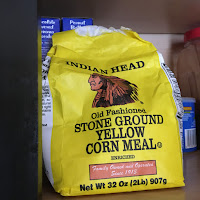
Also at the Center is the impactful, and perhaps not so nice, exhibit "Tonto Revisited: Native American Stereotypes."  It is a room packed full of "Indian Kitch" and wow is it something. Appalling is the word that comes to mind.   As the description on the website says, "On their own, these items can seem harmless, however, when put together, the destructive nature of the imagery is apparent." And I would add the word powerful.  I'll never again look at this bag of corn meal the same. 


On a lighter note, of course our visit to Syracuse  included a stop at the Erie Canal museum, which was pretty cool. Literally, it was freezing outside that day. I think I got excited because the car thermometer indicated it got to 5 degrees! Anyway, inside the museum,  I enjoyed learning more about the Erie Canal, especially going through an actual canal boat and reading about passenger experiences in their actual journals.  Upstairs were some fun installations that recreated historic Syracuse places including a general store, limestone quarry and, the Husband's favorite, a local bar.  


If you travel to Syracuse, we had a lovely brunch/lunch at Oh My Darling, and a fun time that evening with family at Coleman's Irish Pub.

Friday, January 7, 2022

Donkey Basketball

Who would have thought I would be having deep thoughts about Donkey Basketball on this winter afternoon?

It all started when Tom McHugh, a professional photographer whose images were published in the Spotlight and Times Union in the 1970s, sent me a batch of photos he had created. Included were a group from a donkey basketball game at Bethlehem High School.   

At first I smiled, remembering such games from back when I was in high school in the late 1970s in Rhode Island.  They were fun, we laughed at the players and the absurdity  of stubborn donkeys  playing basketball. Then, my modern, 21st century sensibilities started up and all I could think was "Oh, those poor donkeys! What were we thinking?"

This is a tough one folks.  Google around and you will see animal cruelty activists having their say as well as modern donkey basketball operations assuring that their highly trained donkeys are fed and watered properly, indeed, even pampered.  And that the donkeys truly enjoy their job of entertaining people.  

I was struck by some basic donkey facts like a well cared for one can carry up to 50% of their body weight (an average, healthy donkey is about 365 pounds, so half that is about 182). And one site noted that donkeys are much stronger than humans.  You can't drag them anywhere they don't want to go, despite what looks like a lot of pulling in these pictures.

My take?  I enjoyed the nostalgia of these photos and wondered about the crazy things we used to do. But you know, I'm glad we don't have donkey basketball games around here anymore.  


And in case you are curious, donkey basketball became a thing in the 1930s.  Below is a clip from the Ravena News Herald from December 18, 1936. The first paragraph reads:

The donkey basketball game drew a crowd of fans to the high school on Tuesday and they had a great many hearty laughs.  The  antics of some of the local business men trying to handle the donkeys and play ball too, was a laugh feast.  The score was 8 to 14 in favor of the "Never Washers," captained by Max Horelly on "Kate Smith." Albano, astride "Jean Harlow" was captain of the Dirty Faces."


Tuesday, December 14, 2021

Bradt-Oliver House Open House

 The developers of the The Spinney at Van Dyke have graciously agreed to host an archology open house at the Bradt-Oliver House this Friday. Stop by between 10 and 4 and chat with the archaeologists from Hartigan Archeological Associates about their data recovery project. 

I posted here about the house back in 2017 - pop over for a quick read and some great old pictures from the Leonard family. 

https://bethlehemnyhistory.blogspot.com/2017/12/the-bradt-oliver-house.html


I'll be at the open house too and will try to answer your local history questions.  I'll  have copies of the old maps that show the farm.  That would be the 1767 map where it is listed as Adrian Bratt. The 1854 indicates J. Oliver and the 1866 says P.H. Bradt.  

The three families associated with the property, Bratt (or Bradt), Oliver and Leonard, all have deep roots in Bethlehem history. 

While Ralph and Lillian Leonard moved there in the early 1920s with their two sons Irvin and Harold, it looks like they are directly connected to the Olivers through Ralph's aunt Susan who married John H. Oliver.  Who just might, might, be the John Oliver on the 1854 map, altho he would have only been 14 so a tenuous connection at best.  I haven't yet been able to determine John Oliver's parents, but I am wondering if his mother was a Bradt - more research per usual!  

Anyway, the farm remained in the Leoard family until the Spinney acquired it in the 2000s. 

Hope to see you on Friday!


Tuesday, December 7, 2021

Our Towne Bethlehem December 2021: Taking a Break

 Did you know I have been writing monthly articles for Our Towne Bethlehem since January 2013? The first one was published that February. That is nine years of monthly articles and it is time for me to take a break.

I long appreciated the monthly deadline. Sadly, I am a firm believer in procrastination. For me, a deadline, especially because other people were depending on me getting the work done, was essential to, well, getting the work done! But now, that deadline is no longer serving me or my goals.

I am carving out time for other writing ideas, mostly playing with fiction. For the local history articles I write, I strive to be accurate and do a ton of research. But in the end, I am usually still curious about the people and places I write about. There is always more to the story, but it is just impossible to find the details. So, I am going to make some up. That’s what fiction is after all.

Here’s an example, a short newspaper snippet about the doings of a couple of folks from Feura Bush:

“The marriage of Mr. Peter Hedrick and Miss Helen Slingerland has just been made public. They were married in the autumn, but marriage, like murder, will out.” (The Argus, January 28, 1887)

What? Marriage, like murder? What? Don’t you have questions? I know I do. Who is this couple? Why did they keep their marriage secret? How did they keep it secret? Feura Bush is a pretty small village after all. And what about the Slingerland connection? That’s a prominent family name. Historically accurate answers are not forthcoming, I looked. But you know, I can make up a pretty good story about Helen and Peter. Who knows if it will be any good, but I am going to give it a try.

Many thanks to my faithful readers at Our Towne. I have received so much positive encouragement over the years and I really do appreciate that. I will continue to be your Town Historian. Keep the history questions coming and be sure to check back here often. For now, this is where I’ll post the historical tidbits I’d like to share with you.

******

To illustrate this article, I chose some old pictures of Bethlehem people in front of their homes. Each one makes me curious about the story behind the picture. Read more in the captions.


The facts about this picture are simple. Members of the Wilkens family are posing in front of their summer place on Old Quarry Road about 1940. They are likely Sarah Wilkens in the background and two of her three daughters (either May, Bess or Harriet) in the foreground. In my mind, Mother, has just stepped out the door, and now, hand at her throat, is wondering what shenanigans Harry is getting up to at the mailbox. Harry, hand in pocket, is about to stuff an outrageous letter in there. And at the lower left is May, grinning up at her older sister, urging her on to mischief. See how fun this is? 


The only known facts about this image are that member of the Terrel family are posing on a porch step, perhaps the porch of their farmhouse that used to be on Route 32 just before the village of Feura Bush. But, oh the story on that little girl’s face, and her mother’s slanting side eye. Grandma and grandpa just stare at the camera, oblivious to the drama between mother and daughter.


In this photo John L. Winne stands in front of his farm house probably around 1900. This Delmar house has a Roweland Avenue address but nowadays the front façade shown here faces Louise Street. This one is a ghost story for me. Old man Winne is so wizened looking while he casually leans on the post. Surely, he has come back to haunt his old house, now that it is all turned around, the fence long gone and so many other houses have sprung up in his orchards. 


A boy poses in front of the Slingerland Sager house in 1935. The house is still standing near the roundabout in Slingerlands behind the post office. This young boy seems so proud of his jaunty, vaguely nautical hat. What imaginary sailor game is he about to run off and play on the grounds of his grandparent’s home? Perhaps he’ll end up at the old LaGrange family cemetery, not too far away back behind Shop Rite. See how this simple picture just became another ghost story?


These are members of the Welch family on the porch of their Van Wies Point home. What intrigues me are their gazes. The sun must have been very bright in their eyes, but some do look directly at the camera like patriarch Warren Welch in the center. His wife Teresa is behind him and seems to be minding her grandson who is under the watchful hand of his mother. Their son Frank Welch stands tall at the upper right corner. What is he thinking beneath his carefully upswept hair and squinting brows? And sitting on the lower right holding a book is Emma Welch. She is a daughter-in-law and her husband William is not in the picture. And what about Arabella, standing behind her brother Frank? She’s looking out disapprovingly on the whole thing. Just from their gazes, I am imagining a whole story line between these various siblings. 


Tuesday, November 9, 2021

Remembering Dr. Browne

 This little item was handed to me the other day.  Of course, I had to find out more about Dr. Browne.

It turns out this is actually a small envelope that probably held a couple of pills when it was handed to a patient.  And don't you love the office hours, only 2 per day.  And Sundays by appointment!

Harold Roberts Browne was born in 1897 in Cobleskill, his father Leslie was a dentist, his mother Daisy was of course "keeping house."  He attended Albany Medical College, and settled in Bethlehem as early as 1929.  By then he was married to Ruth Knappenberg. I'm not sure how they met, but in 1920 she was a school teacher in Tarrytown. She grew up in the West Sparta area of New York, daughter of John and Ida.

Dr. Browne was much appreciated.  I found several glowing articles about him plus his 1971 obituary.  He was an old-fashioned general practitioner and an early plastic surgeon.  I'll  just quote Edgar S. Van Olinda's tribute in the Times Union (January 1, 1969) who in turn was quoting an anonymous hometown patient: 

"Words cannot portray how many good things Dr. Brown has done in this community of Delmar and its environs... Many an adult has a good-looking face, fixed up by the good doctor.  He was one of the old school who would go to see a patient "in the hills and far away", any hour and weather...  he worked his way through medical school playing the horn, French and English, in orchestras in New York State resort areas... Dr. Browne, although right up-to-date with the miracle drugs of this day and age, remains a shining example of the family doctor, close to his patients when the fee charged was a dollar for an office call ..."

Another tribute mentioned the many babies he delivered, and his obituary mentioned that he remembered making house calls on snow shoes when he practiced up in Clarksville.   Charmingly, the obituary mentions "Dr. Browne's sledding hill." This was the gentle slope between his house at 421 Delaware and his office at 415.

Ruth Knappenberg Browne (1895-1965) was popular around town as well.  She was a very active member of the Delmar Progress Club and a member of the St. Stephen's Church Woman's Guild.  Her obituary noted her charity work. 

I am wondering if there are Bethlehem folks who have memories of Dr. and Mrs. Browne.  I'd love to find a picture of them.

You might recognize the pictures below (stolen from Google of course.)  415 Delaware Avenue is where the couple lived, and Dr. Brown practiced, until about 1947 or 48.  Then they acquired the lovely yellow Colonial Revival home at 421 Delaware.  A quick cut across the side yard, down the sledding hill, across Dyer Terrace, and the good doctor would be at the office.  Interestingly enough, in the Tri-Village directories, the phone number on the envelope above, 439-2323, was listed for both the residence and the office.

421 Delaware Avenue

415 Delaware Avenue


Tuesday, November 2, 2021

Our Towne Bethlehem November: Second Milers

 The phrase “going the second mile” is familiar to us today. It rouses the idea of going beyond the call of duty in helping someone or, perhaps in a work place situation, taking on extra work or responsibilities.  Googling the phrase turns up many Christian/spiritual/inspirational articles all tracing back to the Bible and the story of the ancient Roman road system. A Roman citizen could demand that anyone not a citizen carry their burden along the road for one mile.  In his Sermon on the Mount, Jesus exhorted his followers to carry the load the second mile. Merriam-Webster Dictionary sums up nicely: second mile, noun: a deed of charity or kindness beyond the demands of duty – used chiefly in the phrase go the second mile.

Another idea of the second mile is that after the first mile of one’s life, one enters the second mile, be it retirement, the golden years or even the leisure years. Now that’s a phrase we don’t hear too often – the leisure years.  These days most Seniors lead quite active and involved lives and perhaps there is not much leisure to them.

On their 25th Anniversary, May 1989, Second Milers president H. Neil Smith and founding members Dr. Robert Thomas and Art Westfall get ready to slice the cake.

In 1964, a group of Delmar men combined both connotations when they named their club the Second Milers.  Earl S. Jones, Sr, a retired lawyer and parishioner of the First United Church of Delmar, was the instigator, proposing a club for retired men to meet up once a month for lunch and social time. At their second meeting in July 1964, the group named Howard W. Davenport their first president and chose the name Second Milers as representing that the members were on the second lap of their lives. *

In December that year, a statement about the group’s purpose was read. “The Second Milers of the Delmar Methodist church, a group of retired men, seeks to promote sociability and Christian fellowship among its members, and to render service to the church wherever possible, through their time and talent.”  The group quickly became secular and open to all men of the community.  By the following spring they had eliminated the reference to Christian fellowship and revised the second clause to “render service to the church and community when practicable.”

Over the years, service to the church and community was provided in various forms. Requests for assistance from local charitable groups were regularly read at meetings, and members volunteered as they saw fit.  Painting Red Cross hospital beds, counting donations to UNICEF, serving coffee after church services are just a few.  The list is long and varied.  

But the real focus of the group was the social interaction provided over lunch which was then followed by a program.  And indeed, by 1994, the purpose of the group had been distilled to a purpose of “fellowship to meet for luncheon and then hear a timely presentation on important affairs of the day.”

For years, the men met at the Delmar Methodist church hall. Few early menus survive but one meatless luncheon in February 1967, which happened to fall on Ash Wednesday, featured macaroni, cheese and a tuna casserole.  The cost was 75 cents per person.  For almost 20 years, from September 1971 to May 1991, meals were organized by Priscilla Stevens.  She was in charge of the church’s kitchen and made it her mission to support the men’s luncheon. Menus from her tenure were varied from Sloppy Joes to fried fish sandwiches, and included fruit cups and ice cream. Slowly the price for a meal rose to $3.00 per meal. After Priscilla’s tenure, various caterers were brought in until the group moved over to Normanside Country Club in 2004. They met there for the first time during their 35th anniversary program on May 12, 1999.  That was the first time they met anywhere other than the church hall.  

The majority of Second Milers 56 years of meetings had a program.  Topics were very diverse reflecting members interests and community concerns. Slide shows by members of their various travels were often on the schedule, like Carlton Gordon’s slide show Three Months in Australia and New Zeeland presented December 13,1967. Health and environmental topics came up over the years like the June 14, 1967 presentation on Progress Toward Clean Air & Water or the one from November 1976 about Air Pollution and the Weather. Musical programs were often featured, especially the Friendship Singers. Bethlehem supervisors presented many a State of the Town address, and town historian’s, including yours truly, turned up on the roster as well. How about the October 8, 1969 presentation, simply titled “Prestidigitation.”?  That one sounds intriguing.

Like all community groups and clubs, the Second Milers have had their ups and downs.  They were always an informal group with no bylaws or incorporation.  Membership numbers ranged from 80 in 1965 to 230 in the 1980s.  In 2004, there was some uncertainty about the club’s continuation, but rejuvenated leadership declared the Second Milers “alive and well and pulsating with new energy.”  That energy continued for a while, but the last five years have seen a steady decline in membership, with Covid-19 giving the group its final push.  Their last official meeting, March 11, 2020, just before the pandemic enfolded us, is expected to be their last.

 *I am indebted to John Alden’s 2009 history of the group for much of the information in this article.  And also a shoutout to Bill Fuller and Bob Mulligan, Second Milers who provided a warm welcome every time I spoke to the group.

 Flashes and Dashes

The Bethlehem Historical Association presents Ron Gabriel speaking about the Second Battle of Gettysburg at their November 18 lecture. The time is 2 p.m. Location is the Delmar Reformed Church.  Masks and social distancing are required for this in person event with limited seating. Save the date for BHA’s Holiday Open House, Sunday afternoon, December 12.  The last history hike of the season is a walk at Bethlehem Cemetery, 9:30 am on November 13.  Visit BethlehemHistorical.org for more details.

Second Milers gather at their 25th anniversary celebration. Front row (left to right): Frederick Knapp, William Reuter, John Longley, George Chesbro, Vincent Hummell, and Harold Hastings. Second Row: Donald Stevens, Howard Gmelch, Jack Pellettier, Alan Hoffman, Neil Smith, John Klim, Wayne Fry, and Carlton Gordon.