Tuesday, January 26, 2021

Elsmere Avenue's level train crossing

 Someone just asked me about the underpass/railroad bridge on the rail trail at Elsmere Avenue.  I thought all of you would enjoy these pictures too.  Hard to imagine this was once a level grade crossing!


Looking towards Albany. That's the passenger station on the right, modern day parking lot of the Blanchard Post. That smudge of dirt road over the tracks is Elsmere Avenue. 

Looking towards Delmar. 

Looking towards Delaware Avenue.  CVS parking lot on the left.

Looking south.  St Stephen's on the left, tiny bit of the former grocery store/post office on the right. It is still standing at the top of the stairs which they put in when the underpass was created.  Note the ring from a locomotive.  Those were rung by whacking on it with a hammer for fire calls or other emergencies. 


Thursday, January 7, 2021

Elisha and Catherine Hurlbut, where was your Glenmont mansion? UPDATED - FOUND!

Elisha Powell Hurlbut and Catherine Cuyler Van Vechten, just exactly where was your Glenmont home?

First, pop over here more Hurlbut info:
https://bethlehemnyhistory.blogspot.com/2020/02/thinking-about-name-glenmont-and-elisha.html

Ok, now I usually start with maps when searching for a house, but this time I started with the knowledge that John Eddy (aka Conrad Niver) bought Hurlbut's Glenmont estate, probably around 1906 when he and his wife Nellie moved back to the area. Here's a bit from Eddy's obituary (Ravena News Herald, July 5, 1935):


And, as it just so happens, we have copies of an advertising pamphlet from when John Eddy tried to sell the estate, sometime before it burned down in October 1915, maybe when he and Nellie had decided to move to Madison Avenue in Albany. 

Here are the before and after pictures. The house sure was something! 


The blaze was so intense, and the house so prominent on the hill, that passengers on the late night boat on the Hudson River saw the flames.  While neighbors formed a bucket brigade, the loss was total in part because there was no fire company in Glenmont at that time.

Albany Evening Journal, October 8, 1915


Anyway, the booklet also has pictures of other buildings on the property, including a tenant house, lodge cottage, barn and garage, and farm buildings. Two of which I am sure are still standing, but before we get to that, let's look at the maps. The 1891 Beers is quite clear about the location of the Hurlbut estate.  Note the green patch. That is the location of Beth Emeth cemetery, which is still there on Retreat House Road.  So then it was off on a field trip to Retreat House Road and Halter Road to see what I could see.


On this modern map from Google, find the green patch of Beth Emeth cemetery just below the words "First Student"


The first thing to see is the tenant house, which I am pretty sure is this house. 

This house has a Retreat House Road address. 
If you squint really hard you can see the tombstones to the right of the house.


Now for the Lodge Cottage.  Here she is. This super cool house is really only visible when there are no leaves on the trees. In the old picture, notice the curved detail under the eaves, then compare to the now pictures.  Also the pump house.


Fun right?  So this house has a River Road address, but it is on the corner with Halter Road.  I am thinking that Halter Road was basically the entrance drive to the estate with the house that burned being at the top of the lane. 

The photos below are also from the real estate booklet.  There is an old house at the end of Halter Road which might, might, might, be the barn and garage converted to a single family home.  Notice those three mights - just speculating here.  I was not able to get a picture on my recent trip to Halter Road, plus it has been modified so much it is hard to tell. 


Now of course, I could verify all of this through research at the Albany County Hall of Records.  But with the current Covid situation, I am really not game for that. Hopefully all things Covid will calm down in the next few months and I will feel better about spending time inside doing research. 

From what little I can see with the deeds online at Albany County, Halter Road was subdivided as early as the 1930s - there is a map dated to 1938 entitled "Map of lots on property of Mary Krouse Halter" associated with the lodge cottage property. Intriguingly, the property at the top of Halter Road, #64, has one of those wonderful old descriptions with links and chains and cedar posts on the west bank of the Hudson River. It mentions the VanVrankens and the Van Rensselaers,  excludes out a whole bunch of other deeds (like 40 of them) and mentions the tract of Robert Halter.  It is a confusing mess that doesn't actually mention Hurlbut at all!  

So I am going to let that go for now, secure in the knowledge that I at least know where the old lodge cottage is!

Now about that name Retreat House Road... food for another blog post...

++++++++++++++++++++++++++++++++++++++++++++
UPDATE - June 3, 2021 - FOUND and CONFIRMED

Last week I had the opportunity to visit the property at 64 Halter Road, the owners were wonderful and cordial and showed me about the place.  See the picture below, that is their home, converted by the previous owners from the barn and garage pictured above. While much changed, you can still match it up.


They showed me the spot where the mansion had been, its is obvious when you walk the ground.  There is plenty of concrete remaining from the mansion's basement floor.  Standing there looking down Halter Road,  you can imagine the sweeping view out to the river. Clearly you are standing on the Mount. The land rises up behind you, then folds back into the ravines and plateaus that define Bethlehem's landscape.  The Glen if you will.  No wonder the Hurlbuts were inspired to call the place Glenmont.

We were able to figure out where the farm buildings pictured above were.  But of course were still left with some mysteries.  The estate was a large one, around 100 acres,  with all sorts of outbuildings and structures that have left their mark on the property.   

Many thanks to the Alexander and Rowlands families for solving a history mystery!


Friday, January 1, 2021

Our Towne Bethlehem January 2021: Skiwais and Teunis

 For the past couple of years, I have been working with the Friends of the Slingerland Family Burial Vault on the physical restoration of the site. An important part of the project is developing educational components.  I like to connect local history with wider concepts of U.S. history through the stories of people who lived here.  Like that of Skiwias, chief Sachem of the Mohicans and Teunis Slingerland, a settler who arrived in Beverwyck in the 1650s.

Last month, we had planned to have Slingerland Elementary School students walk over for a visit and to hear these stories.  But, no surprise, Covid-19 had other plans.  So, I share with you what I would have shared with them.  So, get your thinking caps on as we consider Native Peoples and the early Dutch settlement era in Bethlehem.

Skiwias, Chief Sachem of the Mohicans

The land that was to become the Town of Bethlehem was home to the Mohicans for hundreds, if not thousands, of years before the arrival of Europeans. The Mohican lived along the Mahicannituck, now called the Hudson River. They called themselves the Muh-he-con-neok, the People of the Waters That are Never Still.

The river and its surrounding countryside provided an excellent living for the Mohicans, including water full of fish, forests full of deer, and soil full of nutrients for growing of corn, beans and squash. While the Mohicans had a village in Bethlehem near where the Vloman Kill flows into the Hudson, it is not clear if the village was in use when Europeans arrived in the early 1600s.

Skiwias, also known by his Dutch nickname of Aepjen, was an influential Mohican sachem and peacemaker. He was born about 1600, and became the principal sachem around 1645. While several women and many children were part of Skiwias’ family, only his wife, Kachkawo and one of his sons, Sauwachquanent, are identified by name in Dutch records.

Skiwias represented the Mohicans during a turbulent time as the Dutch set up their trading fort at what is now Albany. He helped negotiate and maintain peaceful relations between the Dutch and other Native peoples especially those of the southern Hudson River area, including the Wappingers, the Hackensacks and the Tappans. It was also a time when the Mohicans were in conflict with the Mohawk with whom they fought over territory and access to the Dutch traders at Beverwyck (modern day Albany.)

In the 1650s and 60s, Skiwias was a familiar face on the streets of Beverwyck and the surrounding farms of Rensselaerswyck. (Bethlehem would not become a town until 1793.) He and his entourage were often in town for contract ceremonies and regularly testified in court. He and other Mohicans visited traders, and there is even a record of Skiwias being treated by local doctor Jacob de Hinse.

Skiwias’ documented Bethlehem connection comes in two land deeds between Mohicans and representatives of the Van Rensselaers. In the 1600s, Killian Van Rensselaer was busy acquiring land in order to establish the settlement of Rensselaerswyck.  By the time he was done, the Manor of Rensselaerswyck had grown to 700,000+ acres on both sides of the Hudson River.

On September 12, 1652 “Aepjen alias Skiwias, chief of the Mahicans” witnessed a land sale that covered Nosinaawe’s land from south of the Normans Kill to the house of Cornelis Cornelisen van Voorhout (near modern day Glenmont) and Na’chonan’s land from the Vloman Kill north to the high hill where Aernt Jacobs lived (modern day Van Wies Point.) A July 9,1661 transaction covers the land roughly in between these two parcels including half of Beaver Island. In his account book, Jeremias Van Rensselaer noted that he paid Skiwias and his wife Kachkawo six pieces of cloth, 30 fathoms of wampum, four kettles, six hatchets, six chipaxes, six pairs of socks and 12 knives for this land which is now in the Town of Bethlehem.

By about 1700, the Mohicans had been pushed off their land on the west side of the Hudson River, eventually settling in modern day Stockbridge, Massachusetts.  From there, they were pushed westward, eventually arriving in Wisconsin where their reservation is today.  The Mohicans consider the Hudson River valley, including Bethlehem, to be their ancestral homeland. Today, the tribe owns land in Bethlehem and members regularly visit the area.

Teunis Slingerland, Trader at Beverwyck

Teunis Slingerland was born in Amsterdam, Holland about 1630 and arrived in Beverwyck sometime in the 1650s. Teunis, like most other settlers, engaged in a variety of activities in order to make a living.  In records from the time, he is identified as a “trader at Beverwyck”. He traded for locally produced items like beaver furs, lumber, and farm products, and then traded them for items that had to come from Manhattan, and beyond that from Europe. Items like metal pots, tools, and woven cloth.

While he owned a house and lot at Beverwyck, Teunis also had farm lands along the Normans Kill in modern day Bethlehem.  His Normans Kill farm bordered on the acres of Albert Bradt, the Norwegian for whom the creek is named.  Teunis married Albert’s daughter Engeltie and they had nine children together.  Thousands of people today trace their heritage to these early Bethlehem settlers, Teunis and Engeltie Slingerland, including members of the Friends of the Slingerland Family Burial Vault. 

On May 8, 1685, Teunis, along with his daughter Annejte’s husband Johannes Appel, entered into a land deal with the Mohawk for almost 10,000 acres north of the Onesquethaw Creek and east of the Helderbergs in modern day New Scotland and Bethlehem.  Among other items, they paid the Mohawk three casks of rum, three kettles, and 150 fathoms of white wampum. A Mohican woman, Pawachpanachkam challenged the sale because the land belonged to her and another Mohican, Machaneek. The Mohawks denied this, saying it was their land “won by the sword.” The sale also ran into trouble when Barent Coeymans said he had purchased the same land from the sachems at Catskill (these are believed to be Mohicans.)

Eventually, Coeymans gave up his claim, and Slingerland and Appel agreed to pay the Mohicans for their claim. Slingerland and Appel then ran into trouble with the Van Rensselaers who had also been buying up land from the Native peoples and claimed this property as part of their manor. Eventually, 2000 acres of Slingerlands’ Onesquethaw land was affirmed as being outside of the Manor.

Connections

Teunis Slingerland and Skiwias would both have been out and about in Beverwyck during the same time frame. With such a small population in Beverwyck, it is not too farfetched to imagine that they might have actually known each other.  As Teunis bought and sold furs, Skiwias would have kept an eye on the Mohicans trading with Teunis.   As a noted sachem, Skiwias would have kept an eye on those land deals Teunis was so interested in making. 

“Etow oh Koam, King of the River Nation” by John Verelst.  Etowonkoam was a Mohican sachem of the early 1700s.  This portrait was painted during his visit to London in 1710.


The historic marker in front of this Slingerland family house on Indian Fields Road in the Town of New Scotland reads Slingerland House 1762, Built by Tunis Cornelise Slingerland, Dutch Emigrant 1650, on land purchased from Indians.”  


The Teunis Slingerland House is seen here circa 1933 when it was documented for the Historic American Building Survey.  It is believed that parts of the house date to the late 1600s and early 1700s.  It is on land that Teunis acquired in 1685.


RESOURCES

Visit http://mohican.com/  the website of the Stockbridge-Munsee Community Band of Mohican Indians for an excellent history of the tribe as well as modern news. Historian Shirley Dunn has written several books about the Mohicans including The River Indians: Mohicans Making History, The Mohicans (with Aileen Weintraub) and The Mohicans and Their Land 1609-1730.

The People of Colonial Albany project provides biographies of many early settlers as well as other documents of those early days.
https://exhibitions.nysm.nysed.gov//albany/welcome.html

The book Bethlehem Revisited, edited by Floyd Brewer, is an excellent source for general Bethlehem history including the both archaeology and early settlement.  http://www.bethlehempubliclibrary.org/local-history/bethlehem-revisited-a-bicentennial-story-1793-1993/

For beautiful and historically accurate images of Native peoples and the early settlement of Albany and Bethlehem, check out the paintings of Len Tantillo at http://www.lftantillo.com/

And of course, check out the progress on the Slingerland Family Burial Vault https://www.slingerlandvault.org/


Friday, December 4, 2020

Our Towne Bethlehem December 2020: Keeping the Peace

This article largely skips over what exactly those 18th and 19th century constables were specifically doing in rural Bethlehem.  If you have some insights, please reach out.  Thanks!

Keeping the Peace
December 2020

 Law and order has been a source of concern for Bethlehem residents since the town’s organization in 1794. That year six constables were elected at the annual meeting: John J. Van Derheyden, Milan Warner, Elisha Wyncoop, Hugh McKnab, Den Dimmick and Claus Karkner. Constables, like modern day police officers, were charged with keeping the peace and maintaining public order.

By the early 1900s, the town board was appointing constables, one of whom, in 1924, was David R. Main. Main served until his death in 1949 becoming well known for patrolling the Four Corners on foot with his white bulldog at his side. His cases were frequently mentioned in the newspapers, from rounding up lost heifers in South Bethlehem to dealing with an aggressive “cat burglar” who was breaking into homes in Delmar, Elsmere and beyond. He described that criminal as the meanest burglar he had ever had to contend with. Missing persons, peeping toms, and fire investigations are all mentioned.

In 1941, the town transitioned from a constabulary to a formal Police Department, with Main appointed the first chief. Also transitioning over were constables, now patrolmen, C. Arthur Blodgett and John A. Hotaling. A police department of three was deemed sufficient by the town board for the growing suburbs of Delmar, Elsmere and Slingerlands, and the more rural Glenmont, South Bethlehem and Selkirk. Officers worked closely with the New York State Police on keeping the proverbial peace. The Bethlehem Police Department has gone on to grow and professionalize. It became one of the first to be accredited by the New York State Law Enforcement Accreditation Program in 1990, a recognition that is still in place today.

Bethlehem residents’ concern for law and order was also realized in two different mutual aid organizations: the Bethlehem Conscript Society and the Bethlehem Mutual Protective Association.

The Bethlehem Conscript Society was organized in 1874 to pursue and recover horses and wagons stolen from members. Founders included former town supervisor Albertus Becker and former town clerk William Kimmey. The Society met for at least 20 years as evidenced by their August 31, 1895 annual meeting announced in the Coeyman’s Herald. At that time William Kimmey was still the treasurer of the group. Such banding together for the mutual aid was not that unusual in rural, upstate New York. The Kinderhook Conscript Society was formed in 1808 for the pursuit of horse thieves. It continued until at least 1934 when one newspaper writer wondered “why the Kinderhook Society did not adapt itself to the changing conditions and start chasing automobile thieves…but there are traditions which gave the society the right or privilege to round up snatchers of horses, while to the police is left the job of recovering motor vehicles.”

The Bethlehem Mutual Protective Association was incorporated in 1909 with the express purpose of guarding against theft, trespass and malicious mischief. At the beginning there were several hundred members, most of whom were farmers, from Coeymans, Bethlehem and New Scotland. A snippet in the October 28, 1910 Altamont Enterprise sums up why someone would join the group. “Mr. Van Wie was unfortunate in having his horse stolen last Wednesday night, but had the good fortune to recover the horse and outfit after considerable trouble and expense. He contemplates joining the Bethlehem Mutual Protective Association”

The group pursued offenders both big and small, sometimes offering rewards, like the $50 award offered in 1911 for information leading to the arrest and conviction of the parties who stole the chickens from John Patterson, Glenmont, or the $50 offered in 1914 for the person who stole the horse from the pasture of Elisha Stoff. They were active in the apprehension of Chicken Charlie, Charles Rathke, an unrepentant chick stealer. 1917 brought a rash of “automobile parties with motor cars, cycles and hunters making raids upon orchards and gardens and helping themselves to fruits and vegetables.” Drugstore robberies and blanket thefts are also mentioned in the papers.

Besides pursuing criminals, the group promoted community efforts like “contributing food stuffs to the Empty Stocking Fund” and an effort in 1933 to remove unsightly billboards. The Association met annually to conduct business, elect officers and enjoy a clambake or turkey dinner. They were active at least until the late 1930s.

A word of note, the various newspaper clippings sometimes refer to members of the Bethlehem Mutual Protective Association as officers, even using the word police officer on occasion. This group was a private organization, representing their members, not the Town of Bethlehem. Indeed, at one annual meeting of the Guilderland Mutual Protection Association, after being addressed by Surrogate Glenn who told of the work of the Bethlehem group and “how thievery had compelled the farmers to organize for mutual protection and the excellent results therefrom,” Attorney Barkhuff then spoke at length, and “emphasized the fact that the Protective association stood for Americanism, law and order. He made a plea for the proper administration of justice, rather than take the law in our own hands.” (Altamont Enterprise, October 21, 1921)

The Bethlehem Conscript Society and the Bethlehem Mutual Protective Association are part of a long line of community groups that organized around a perceived need. As Floyd Brewer wrote in concluding the Community Organizations chapter of Bethlehem Revisited, “Looking back over the mass of data on community organizations assembled for this chapter, one is struck by the enduring quality of a large number of Bethlehem groups… many were founded by forceful leaders who left a legacy of group structure to fill varying needs, to resolve problems and to enhance the cultural life of a dynamic, growing community... In short, citizens will find ways of addressing their problems and needs through organizations in every age.”


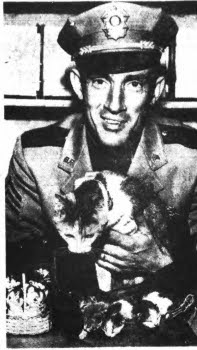
Sgt. John Van Nosdall is seen here in April 1965 with Calico, Bethlehem’s very own police cat. Calico took up residence in town hall, bedding down in Police Headquarters, patrolling the various offices and attending town board meetings. She was known for her diet of cat food and fish. The occasional mouse was consumed, according to Capt. Robert Foster, “Only if they violated the law.”


Police Chief David Main, left, is seen here at a 1942 Lincoln Day dinner at the Ten Eyck Hotel along with Bethlehem Judge William Comstock and his wife. Next to her is Arthur Blodgett, a Bethlehem police officer, who served as chief after Main, and retired from the force in 1959.


Sgt. Pat Dorsey places his cap on on Meg Lierheimer, March 25, 1973


Members of the Bethlehem Mutual Protective Association posted signs as a warning to would be thieves and trespassers.  


Thursday, November 5, 2020

Bethlehem views from the Studio of the Eastern Illustrating Co

Back over the summer I was obsessed with postcards from the Eastern Illustrating Company of Belfast, Maine and kept meaning to write up a blog post.  Then I got distracted by the 1898 assessment roll.  

Now, I am back to it. First, a little background, then a whole bunch of photos that you will spend hours poring over.  Believe me, I have.

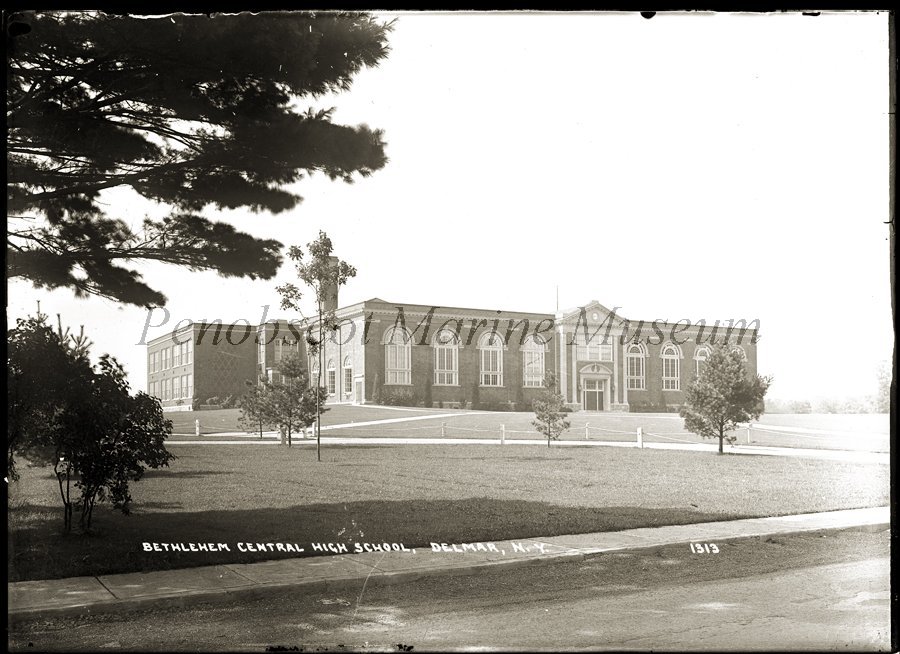
So, I have seen the logo above on several postcards in the town's historic photo collection.  It got me to wondering about what a company in Maine had to do with Bethlehem.  Googling around led me to the website of the Penobscot Marine Museum and the most astonishing collection of "real photo" postcards and the glass plate negatives they were created from.  Basically, from 1909 to 1947, the Eastern Illustrating Company sent photographers all over the northeast to take pictures of notable local sites that they then turned into postcards.  Go to their website and read all about it. 

https://penobscotmarinemuseum.org/eastern-illustrating-publishing-company/

In searching their database, I found that photographers visited Clarksville, Delmar, Elsmere, Feura Bush and Selkirk. Interestingly, there are several cards from Slingerlands that are in the town's collection, but not in the online database. They've also got a couple of Delmar places listed as Elsmere and vice-versa.  I'm also wondering about Glenmont, South Bethlehem and Cedar Hill. So, I emailed the curators.  I'll let you know what I find out. 

The images I found on website are awesome, many of which I have never, ever, seen before.  I could write whole blog posts on each one of them. Like this one about Piney Rest which I wrote without even knowing it was an Eastern card until it popped up on the database. 

 https://bethlehemnyhistory.blogspot.com/2020/07/piney-rest-farm.html

All of the pictures below are taken from the Penobscot Marine Museum website and are inscribed with the museum's watermark.  You can purchase clear copies from the museum, and please do! They've got 50,000+ images to archive and they could use the money.

https://penobscotmarinemuseum.org/historic-photo-prints/

And without further ado I give you the postcards that are on their website. Enjoy. 
(PS - I tried to put them in some semblance of order, note that most pictures are numbered.  It looks like the lower numbers are of an earlier date.)

Clarksville


Delmar


Elsmere


Feura Bush


Selkirk