Saturday, January 27, 2024

Bill Ketzer - TOB Historian

Wow - it has been a while since I posted here!

I am still doing history things and am president of the Bethlehem Historical Association. Pop over here for a recent Spotlight article on the doings at the Cedar Hill School House Museum. 

https://spotlightnews.com/towns/bethlehem/2023/12/27/items-from-1940s-bethlehem-on-display-at-bha-museum/

Today's post is to encourage you to follow Bethlehem's current historian, Bill Ketzer, on his Facebook account. Search for Bill Ketzer, Town of Bethlehem Historian and give him a follow. 

He is writing and posting some really marvelous stuff.

Here's a screenshot of today's post.


(Sorry, I know it is blurry.) He is writing about a visit to the former Heath Dairy Farm.  You can read his article over here in BHA's recent newsletter.

BHA Fall 2023 Newsletter

Also, he writes often for the BHA newsletter, so browse around the other issue here:

https://www.bethlehemhistorical.org/newsletters 

Below is one of the pictures from the Facebook post with Bill's caption.

Yours truly, talking Heath history with Trevor Heath Thayer (great-grandson and Rick Thayer (grandson). It's truly a gift when you can walk an historic property with those who worked, played and hunted on it. Pictures: Lauren Chiyoko Axford


Friday, August 4, 2023

Alfred Webster's photo album

Don't you just love these old photo albums? The embossed surface? The fancy clasps holding it shut? The sheer, weighty heft of them? 


And then, if you're lucky, you open it up and low and behold, the pictures are labeled with names.  Amazing. Now to figure out who these people are and if they have a Bethlehem connection.*
Alfred Webster
The first photo is an older gentleman named Alfred Webster.  We'll get to him in a minute because the real key to figuring out the album are the next two pictures.


It's labeled Alfred Webster father of Olive, Floyd, Raymond & Harold.


On the opposite page is this picture labeled Helen Florine Olmstead m. Alfred Cutler Webster.

A quick hop over to Findagrave and things begin to fall into place. 

Alfred Cutler Webster, 1870-1956, is buried in the Acra (Greene County) Village Cemetery along with his spouse Helen Florine Olmstead Webster, 1870-1942.  Finda lists their children as Floyd James (1896-1982), Raymond Willis (1899-1970) and Harold (1905-1928).  Finda does not have their daughter Olive here. According to the photo album, she married someone named Simpson or Simpkins and I haven't tracked her down. 


Finda lists Alfred's parents as James Leander Webster (1824-1905) and Maria Kniskern Webster (1828-1907).  When I looked up James on Finda, it lists his father as Russel Webster (1783-1870). This is most likely the old man pictured at the front of the album.  I'm thinking the photo was taken near the time of his death in 1870.


Also in the album are Jarvis Webster and The Rev. Erastus Webster. I found an interesting newspaper clipping in the legal case of Erastus Webster vs. Jarvis H. Webster in the case of land owned in Cairo by Russell Webster, deceased.  (Cairo by the way is right next door to Acra - Catskill Recorder Nov. 20, 1874)  I'm thinking these two are sons of Russell.  Check out the family resemblance.


In the album too is this picture of Maria Kniskern - might that be Alfred's mother who was born in 1828 and died in 1907? Probably. 


There are a bunch more labeled pictures in the album related to the Webster and Olmstead family.  But there are two of a man named Oscar Oatman.  In an admittedly quick look, I couldn't find anything about him.  And he looks so handsome in his uniform and with his bowler hat. 


So there you have it, a little exploration of what you can (sometimes!) find out if the pictures have names on them. 


*This little research project happened because I was helping out the registrar of the Bethlehem Historical Association figure out if this album should be accessioned into the BHA collection. I'm the new BHA president in case you didn't know and am officially retired as Town of Bethlehem Historian.


Thursday, June 22, 2023

Charlotte and John Van Allen

 Recently I’ve been doing some research about 1940s Bethlehem, especially the development of the zoning code and planning board.  Any thinking about zoning in Bethlehem must include Howard P. Paddock, real estate developer and planning board chairman. He lived for many years at 420 Delaware Avenue, a lovely brick home built about 1852 for Dr. John Van Allen. According to Allison Bennett, Van Allen was “one of our town’s ‘horse and buggy’ doctors.”

In another post, I’ll get back to Paddock.  For now, I want to tell you about the Van Allens.

Heres' the house in 2012

This is one of my favorites houses on Delaware Avenue with its brick stylings, front porch, hip roof, carriage barn and four-acre setting, I always seem to fall into the trap of referring to it as the “Dr. Van Allen House” without thinking too much about it. But Dr. Van Allen didn’t live there nearly as long as his wife Charlotte or son Theodore. So down the history rabbit hole I went.

Backing up in time from when the house was built in 1852, the land was part of a 275-acre parcel that was leased by Stephen Van Rensselaer to James McKee in 1803. In the ensuing years, the land was divided up and parcels sold to various Bethlehem families with familiar names like Adams, Hallenback and Winne.  Dr. John Van Allen acquired about 14 acres in the 1850s and he is probably the one who had the house built.  

Van Allen is also a familiar Bethlehem name. But, there are so many John Van Allens I gave up after finding the 1850 Census which clearly has my John Van Allen. He is age 39, a physician with real estate property valued at $4000.  Interestingly, his spouse is Lucy, age 36. The only other person in the household is Elsa Sager, age 30, who is likely a servant.

Now skip forward to the 1860 U.S. Census.  Here is John G. Van Allen, age 49, physician, with real estate valued at $5000 and personal property valued at $5000.  Quite well off were the Van Allens.  Next is his wife Charlotte, age 39, born in New Jersey. Lucy age 9/12, and two servants Elsie Sager and Eleanor Cook. I am assuming the Lucy in the 1850 census was his first wife, although I could not find a death record on her. Did you notice little Lucy, only 9 months old? Maybe she was named after wife #1.  And how about Elsie Sager? Looks like she worked for the family for at least ten years.   

John and Charlotte were married in 1858. They had 3 children together, Louisa, who died at age 16 in 1876 (the Lucy listed in 1860), baby James who only lived a year and a half and Theodore born in 1861 who went on to be a physician like his father. Dr. John died in 1879 when he was about 68, so he and Charlotte were married about 20 years.

I could find little info about how Dr. John was related to the many other Van Allens that lived in Bethlehem. But, Googling around on Charlotte turned up all kinds of interesting facts about her family in New Jersey.

Charlotte Mercer Cornell was the daughter of the Rev. John Cornell and Maria Frelinghuysen.  The Frelinghuyens were a big deal in New Jersey politics and society. Her grandfather was Frederick Frelinghuysen (1753-1804) a Revolutionary War General and U. S. Senator from New Jersey. By the way, her grandmother, General Fred’s wife, was Gertrude Schneck (1753-1794).  Charlotte’s uncle Theodore Frelinghuysen (1787-1862) was one of several New Jersey political bigwigs named Frelinghuysen. Both her father and her brother were Reverends.

 My big question is how did Charlotte meet John Van Allen? A mystery.

After her husband’s death Charlotte lived in the Bethlehem house while her son Theodore was studying medicine.  He graduated from Albany Medical College in 1883. Follow the link below to a very nice write up about him published after his death in 1902.  My favorite quote “At times apparently brusque and unsympathetic, he was ever generous to a fault and loyal beyond measure.”  By 1900, mother and son were living at 48 Eagle Street in Albany. The census page caught my eye because there were four physicians living right next to each other at 42, 44, 46 and 48 Eagle Street. That would be George Lempe, Arthur Sautter, Arthur Root and Theodore Van Allen.  

Charlotte Van Allen, born April 13, 1822, died September 12, 1903. Shortly after that her Bethlehem property was sold and eventually came into the hands of George and Belle Paddock who in turn sold it to Howard P. Paddock.

General Frelinghuysen

Theodore Frelinghuysen

Theodore F. C. Van Allen, M.D.


LINKS in no particular order...

https://www.findagrave.com/memorial/7474887/theodore-frelinghuysen

https://sparedandshared.wordpress.com/letters/1839-charlotte-mercer-cornell-to-rev-frederick-frelinghuysen-cornell/

https://www.newnetherlandinstitute.org/history-and-heritage/dutch_americans/frederick-frelinghuysen/

https://books.google.com/books?id=4TZYAAAAMAAJ&pg=PA672&dq=Theodore+Van+Allen&hl=en&newbks=1&newbks_redir=0&sa=X&ved=2ahUKEwiLyvSaotX_AhVzFlkFHez8Cu8Q#v=onepage&q=Theodore%20Van%20Allen&f=false

https://knowingnewark.npl.org/the-frelinghuysens-when-jerseys-imperial-family-reigned/


And finally, in case you are curious like me, here is a Street View photo of #42 Eagle Street. Charlotte and Theodore probably lived in a similar looking house - now the parking lot on the left. 


Tuesday, April 11, 2023

Where am I #4


Ok - so I am not in Albany County, but last Friday I visited Petersburg National Battlefield in Virginia and remembered the Bethlehem men who fought, and died there. It was the map below with The Wilderness right at the top that really jogged my memory.


The book Heroes of Albany County by Rufus Clark published in 1866 has write ups about the many people from Albany who died during the Civil War. Here are the four from Bethlehem that died in the battles/campaign on the map. 

James Herring, of Bethlehem, enlisted in Company C, Seventh Regiment, August 1862, and was killed in the battle of the Wilderness.

Stephen Walker, of Bethlehem, was born in Glarken, Scotland, in 1835. He enlisted in Company C, One Hundred and Twenty-first Regiment, August 1862, and was killed in the battle of the Wilderness.

Peter Taylor, of Bethlehem, was born July 10, 1818. He enlisted in Company K, Seventh Regiment, August 8, 1862, and was killed at Reams’ Station, August 25, 1864. While not on this map, Reams' Station was just south of Petersburg.

 And then there is  David Burhans. He has a much longer write up in the Heroes book, as well as in Bethlehem Revisited.  Below are highlights from Heroes.

Capt. David Burhans, of Company H., Forty-third Regiment N.Y. Volunteers, was born in the town of Bethlehem, Albany county, June 24, 1840.

He participated in the battles of Fredericksburg, Chancellorsville, Gettysburg, Rappahannock Station, The Wilderness, Spotsylvania, and other engagements previous to the battle of Po River, where he fell, in the front of that conflict, on the 10th of May, 1864.

He was a young man of unblemished reputation, and highly respected by all who knew him, for his many virtues. 

Capt. Burhans

Read more about Burhans in Bethlehem Revisited:

Read more about Samuel West who served with New York's 7th Regiment Heavy Artillery during the Overland Campaign Movements on the map.  As the article says, he was wounded June 3, 1864 at Cold Harbor; captured June 16, 1864 at Petersburg; paroled, February 27, 1865 at North East Ferry, NC; mustered out, May 21, 1865 from hospital at Albany.


In general, read more Bethlehem Civil War stories by just searching my blog.

And finally, at Petersburg I learned the fascinating and tragic story of the Crater.  Where Union forces (or the Federals as signage at the park says) managed to snatch defeat from the jaws of victory.  Basically, Union troops secretly tunneled under the Confederate line, detonated the underground explosives and blew a big hole in the ground.  Federal troops advanced and were soon trapped in the hole. The whole thing was a big bloody deadly mess. Which is kind of how I think of the Civil War in general. An absolutely necessary war but wow, so many many people died and the country was so torn apart. 

Get thee to Google for more details of the Battle of the Crater. Here's a picture to the entrance to the mine. The actual crater is literally a big hole in the ground, now softened with green grass and pine trees.


Monday, March 13, 2023

Where in Albany County #3


Yesterday I was down at the Ravena Coeymans Historical Society for a talk by Dennis Whalen about this wonderful birds eye view that was published in 1889.  Whalen used the 30+ points identified on the map to give a history of the town and especially Coeymans Landing.  A very informative talk. 

One point that caught my eye was the steamer Lotta. She was a great old steamboat that in the late 1800s made twice a day runs between Albany and Coeymans with stops at the "way landings". And what were those way landings? That would be Bethlehem's very own Cedar Hill and Van Wies Point. 

I think this is Coeyman's Lotta.
At any rate it is a similar steam boat! 

It reminded me about how the Hudson River really was a super highway back when the roads were terrible.  Poking about on the old newspaper websites, I found this detailed article about a big party at  "The Lions."  You saw one of the lions from The Lions in last week's post on Henry Hudson Park. 


Here's a transcript of this fun party!

AT “THE LIONS”

Reception By Mr. and Mrs.

James B. Lyon at Cedar Hill

AN IDEAL HOST AND HOSTESS,

IDEAL PLACE AND NIGHT.

Merry-Making in the light of the

Moon – a Charming Social – Event

Last Night’s Brilliant Adieu to the

Summer Season

      An ideal night, ideal summer home, ideal host and hostess. Such was the summarized opinion of the numerous friends of Mr. & Mrs. James B. Lyon, who assembled last night at their charming place on the Hudson at Cedar Hill. It was an adieu to the summer season, and a very graceful one it was. In bidding adieu to host and hostess in the small wee hours this morning, everyone one of the guests was impressed with the rare charm of hospitality, whole-souled cordiality and unaffected warmth of welcome which made the reception so delightful. The scene at “The Lions” was exceedingly picturesque. The moon in unclouded beauty shed a lustre over the undulating slopes and wooded knoll that extended from the broad piazza of the cottage to the river itself. Under the swinging lights that surrounded the cottage was assembled as merry a party as rate old Albany could get together, one and all in joyous mood and loud in their praises of the charming spot…

     About 8 o’clock in the evening the steamer Lotta, which was specially charted for the occasion, left the foot of State street with the blithe company of guests…At Cedar Hill carriages and carryalls conveyed the company to “The Lions.” …

…All the arrangements for the reception and comfort of the guests were perfect and yet carried out with seeming informality that made the occasion the more pleasurable…

(Albany Times Union, September 9, 1897)

***

If you haven't been the the Ravena Coeymans Historical Association's museum, please do visit.  It is worth the trip, just chock a block full of local history. And since they are Bethlehem's next door neighbor, lots of connections to Bethlehem history as well. 

Here's link to their website: https://coeymanshistory.org/

And if you want more info about Hudson River steamers, BHA is having a talk in April about that very subject.  Pop over here for info:

https://bethlehemhistorical.org/2022-2023-speaker-series

And since I am promoting stuff, BHA is hosting a fundraiser called Afternoon Tea on the Titanic that features The Unsinkable Molly Brown, plus yummy treats of course.  More info on the BHA website. 

https://bethlehemhistorical.org/


Sunday, February 26, 2023

Where in Albany County #2

 Sunday afternoon, about 3:45, partly cloudy, 40°, low tide


I hope you've guessed I had a lovely walk at Henry Hudson Town Park this afternoon.  

The slanted afternoon sun came in and out of the clouds as I walked along the river enjoying the crunch of the light snow underfoot and the towering cotton woods above.  What massive trees.  With the erosion along the shoreline, a couple are just about ready to fall into the water. 

About the pictures - of which I would have taken more if my phone was not on 1% - top to bottom.

Behind the Canada geese you can see the hulk of an old barge. At low tide, if you dare to approach more closely by clambering over the fallen beech tree, you can still see the iron cleats where ropes were tied off and also the heavy decking boards. Slowly, after 100 years or more of being stuck there, it is rotting away.  

Through the brambles in the foreground of the next picture you can glimpse one of the interesting pieces of industrial remains that are by the water.  This metal object might have been part of the ice warehouse or dock that used to be here. The Hudson has been a working river for a very long time. The channel and shorelines have been changed significantly over the years since Henry Hudson came along in 1609.  

In the next photo, in the distance is Barrent Winne's house.  Hard to believe there used to be a busy wharf here complete with warehouses, general store and ice house.

Next is the deeply creased bark of a cotton wood tree.

After that is a piece of farming equipment near the side of the road on the way into the park.  Its wheels and tines blend in with the wild brambles. J. B. Lyon used to have a large estate here, his big mansion burned down in the 1960s. Farming did happen here, and Lyon also had apple orchards.  The next picture shows one of the lions that guard the entrance to the carriage roads that wind thru the estate.

Lastly is the sign at the top of the hill going down into the park.  

I wish I had had the battery power to take some snapshots of the waterfall on the Vlomankill and the wonderful mansard roof of the Best house.


Wednesday, February 22, 2023

Where in Albany County Am I - #1

Wednesday morning around 9 am, mostly cloudy, about 35°

Scroll along the pictures, all taken this morning, and you can figure out where I am.  They get more specific as you go along.


I'm at the Normanskill Farm Park, of course! It is in the City of Albany, just off of Delaware Avenue, a wonderful place with lots of history.  

The park is the former Stevens Farm, part of the expansive Norman's Kill Farm Dairy operation. On this farm, established about 1900, Mark Stevens and his crew raised turkeys, laying hens, and hogs, They milked 40 Golden Guernsey cows twice a day.  The larger Norman's Kill Farm Dairy also included a dairy on 9W in Glenmont (about where Walmart and Lowes are today) where 200 Guernsey's were milked, a large bottling plant in Albany (demolished for the Albany South Mall project), a milk receiving station in Washington County and a skimming station in Westerlo.  Plus an army of home delivery wagons and trucks. 

In 1975 Crowley Foods purchased the Norman's Kill Farm name and business, and in 1980 the City of Albany acquired the property I visited this morning. 

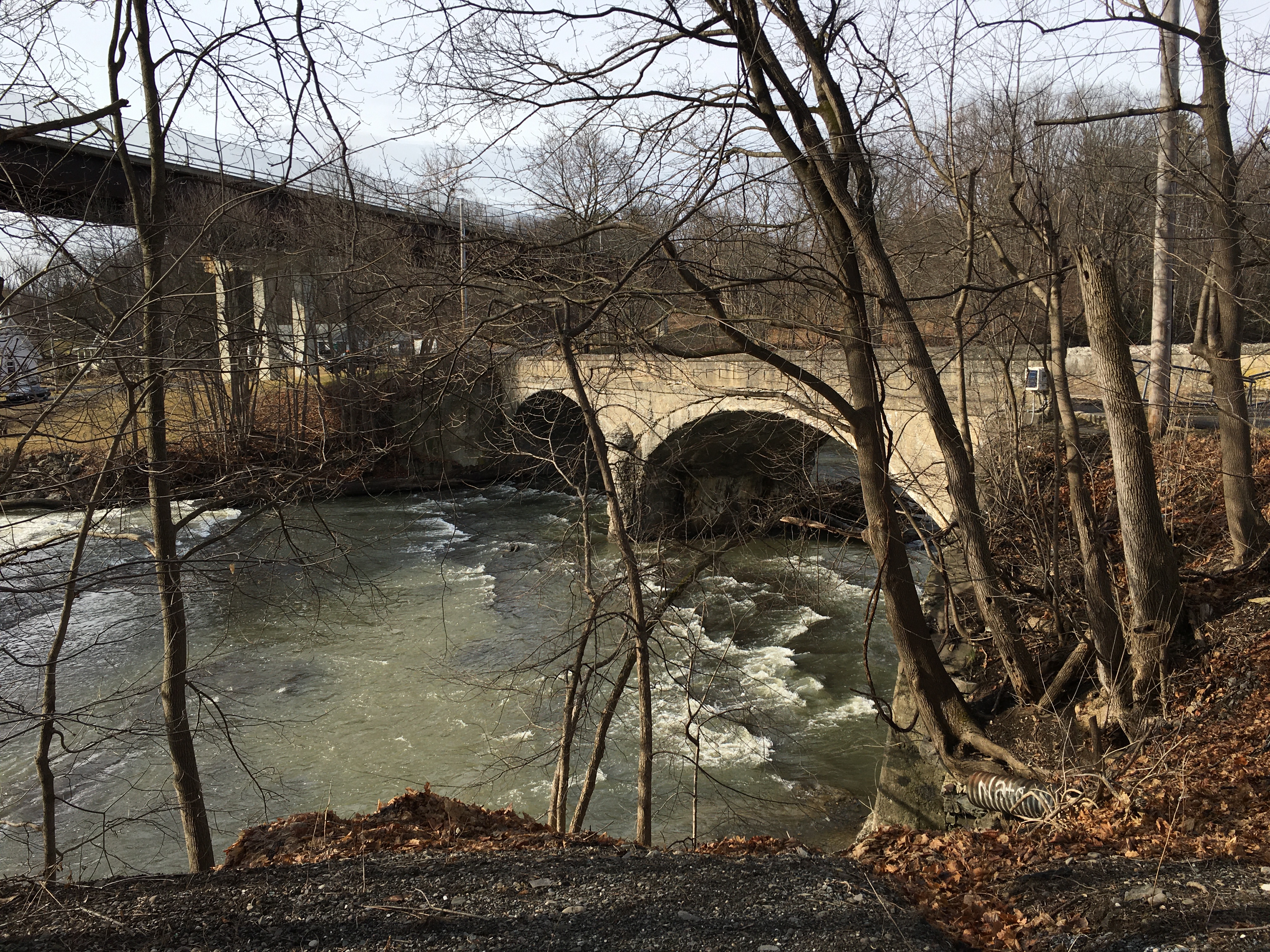
Walking here can seem so rural and bucolic, but you are definitely surrounded by our busy community.  The high bridge carrying Delaware Avenue over the Normanskill practically buzzes with traffic. The low concrete bridge, part of the old Yellow Brick Road and closed to vehicles, is crumbling but you can still walk over it. With some imagination, one can visualize the mills, ice houses, blacksmith shop, and taverns that used to be here. Plus, homes, a church and a school. I try and imagine the tollgate on the west side of the bridge where keeper Peter Esmay collected three cents for travel on horseback via the old Delaware Turnpike. 

It was a varied place on both sides of the creek. Now, it is a quiet bedroom community - quiet except for the sound of water rushing over the rocks in the channel, and those cars and trucks zipping over head.  

The Whipple Truss Bridge pictured above was constructed in 1867 in Syracuse and moved here in 1899.  It connects the Stephens Farm to the road that used to be the Delaware Turnpike.  Now that Delaware Avenue travels up high, this low route is called Normanskill Drive.  The bridge is an engineering gem and one of the very few such iron bridges still in existence.  Also, its fun to walk over!

One surprise on my walk today was how active the beavers have been along the creek - this is down by the dog park and community gardens.  There won't be many trees along the banks if they keep it up.  I couldn't see a dam or a beaver lodge - more exploring is needed!